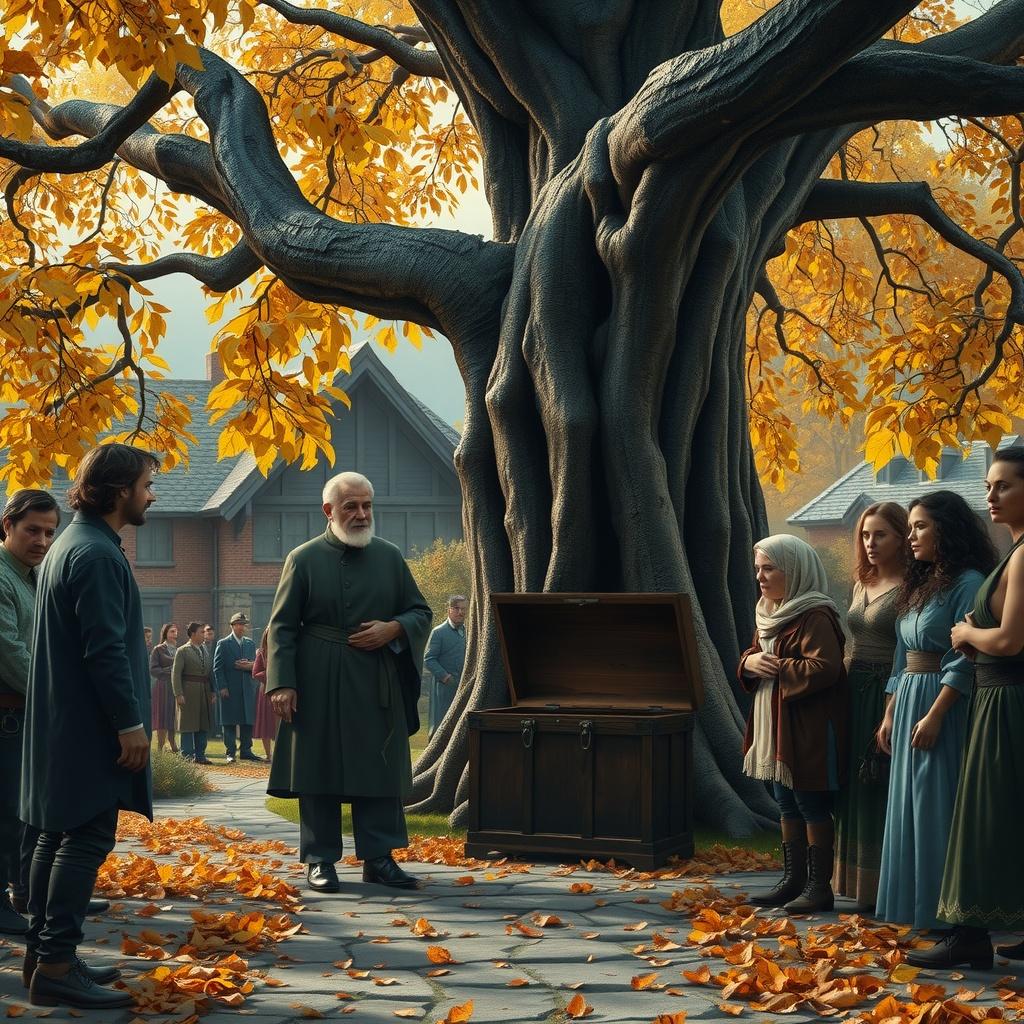
In a small, isolated village nestled in the hills, there was a tradition that everyone followed without question. The Harvest, as it was called, was an event that took place once a year, just after the first leaves began to turn gold in the fall. The villagers believed it was a ritual as old as the town itself, one that guaranteed prosperity for the year ahead. Each year, the villagers gathered in the town square for the event. It was a peaceful and even festive occasion, with children laughing and running about while the adults chatted and made small talk.At the heart of the village stood a large, weathered oak tree, its gnarled branches stretching into the sky. Beneath the tree was a wooden chest, old and chipped from decades of use. This chest was the center of the Harvest. The villagers knew its importance and treated it with great reverence, as it was said to be the key to their survival. Each year, the chest was filled with slips of paper, each one representing a different member of the community. On the day of the Harvest, the chest was placed under the oak tree, and the lottery began.The head of the village, a man named Elder Korrin, was responsible for overseeing the event. His eyes were sharp and his voice deep, but his face was always calm, even when the chest was opened and the slips of paper were drawn one by one. The villagers, standing in a large circle around the chest, watched in silence, knowing that the name drawn from the chest would determine the future of the community.This year, the event began as it always did. The villagers gathered under the tree, the scent of autumn filling the air. The children, eager as ever, played in the falling leaves, their laughter ringing through the square. The adults exchanged pleasantries, but there was a tension beneath the surface, a quiet anticipation that was not entirely understood by the younger generation.When Elder Korrin opened the chest, the villagers fell silent. The slips of paper were drawn one by one, each name carefully read aloud. Finally, it was time for the last draw. Elder Korrin held up the last slip of paper, the moment of truth upon them. A hush fell over the crowd as the name was read aloud: "Lena."Lena was a young woman, just barely out of her teenage years. She stood frozen, her face pale as a cold wind swept through the square. She looked to her parents, who stood in the crowd, their eyes lowered to the ground. They did not meet her gaze.Lena stepped forward, the weight of her fate heavy on her shoulders. She had heard the stories of the Harvest, of how it had been carried out for generations, but she had never truly understood its meaning. No one spoke of it openly, but everyone knew what it was for. Prosperity for the village could only be ensured by the sacrifice of one. The chosen person would be taken to the center of the square, and the villagers would take turns placing their hands on the chest, invoking the spirit of the harvest. It was said to be a gift to the land, a blood offering that would bring an abundance of crops, bountiful harvests, and good fortune.But this year, something was different. As the villagers closed in on Lena, she felt an unfamiliar stir in her heart. It wasn’t fear, but anger. Why must it always be one of them? Why must they sacrifice a life for the sake of crops, when there was no guarantee that the harvest would come? Why had no one questioned the practice? Why had they all blindly accepted it?With a sudden surge of strength, Lena cried out. "No! This is wrong! We don’t need to sacrifice anyone. We don’t need to keep following this tradition just because it’s always been done. Why don’t we try something different? What if we live without the Harvest, and trust in each other instead?"For a moment, there was stunned silence. The villagers stood frozen, their eyes wide with disbelief. Elder Korrin stepped forward, his face unreadable."You know what will happen if we stop," he said quietly, almost sorrowfully. "The harvest will fail. The crops will wither. The animals will starve.""I don’t believe that anymore," Lena replied, her voice firm. "I believe we can survive without this bloodshed. We don’t need to keep following a tradition that demands a life for the sake of something uncertain."The crowd shifted uneasily. Some nodded, as though the words made sense, but others murmured in fear. They had never known a life without the Harvest. For generations, it had been their way of life. They had built their community around it. To question it was to question their very existence.But Lena stood tall, her heart racing but her resolve unyielding. "We can find another way," she said. "We must."For the first time in the village’s history, the Harvest did not occur. There was no sacrifice, no death beneath the oak tree. And though the villagers feared that disaster would strike, the crops grew that season. The trees were full, the fields ripe with grain, and the animals flourished. In time, the village began to thrive, not from ritual bloodshed, but from the bonds they forged with each other.Lena had broken the cycle. And in doing so, she had ensured that life would go on—not through the taking of life, but through trust, community, and change.
The Harvest Reimagined
Make your ownBy: Shilhi
✨ AI Storybook · 37 pages · ~15 min read
Cast
EL