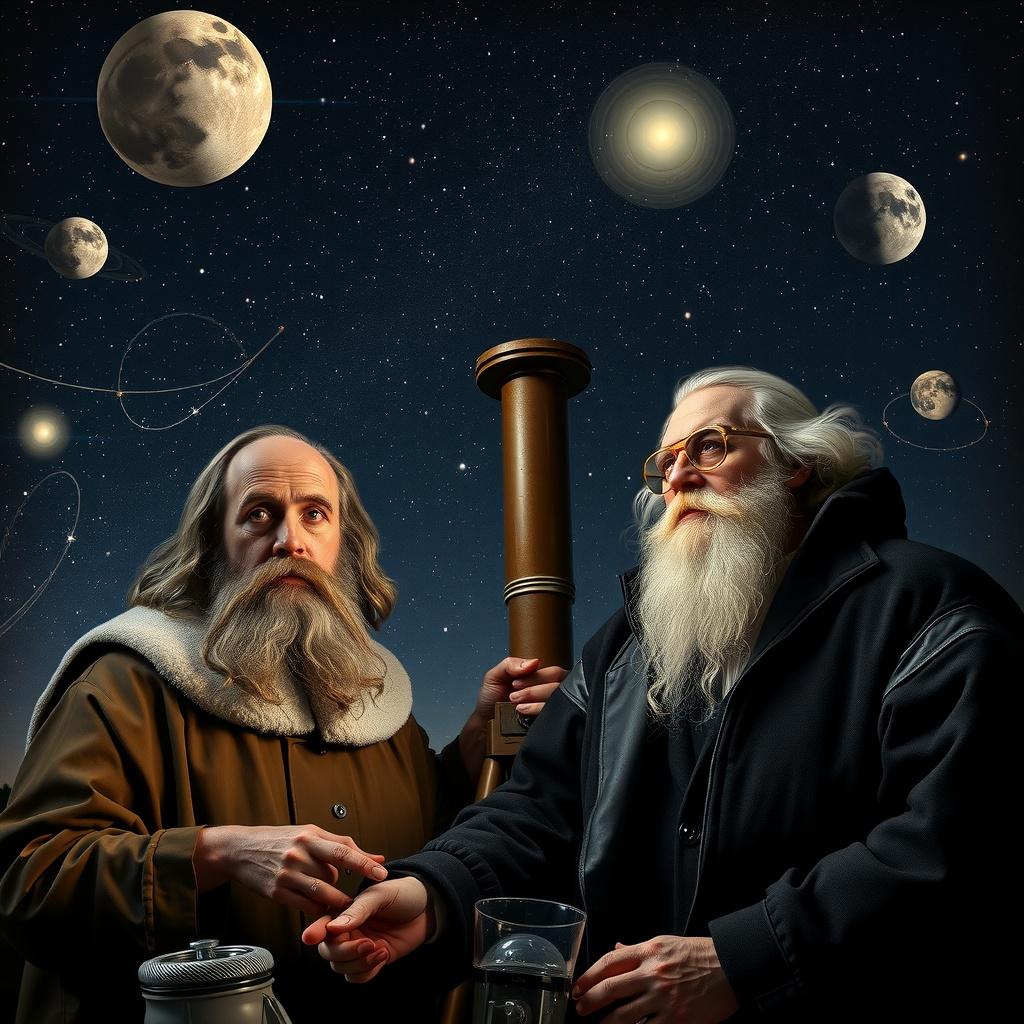
Galileo Galilei stood at the entrance of his modest observatory, a welcoming smile on his face as Johannes Kepler approached. "Welcome to Padua, my friend. The stars await us tonight," he greeted warmly.
Kepler ran his fingers over the polished wood of the telescope, his eyes gleaming with anticipation. "I've heard much about your invention, Galileo. Let us see what truths it reveals," he remarked, positioning himself to peer through the lens.
Galileo and Kepler exchanged theories, their voices rising and falling like a symphony. "The moons of Jupiter," Galileo insisted, "move in a pattern that defies the Ptolemaic system." "Yet, the harmony of the spheres," countered Kepler, "suggests a grander design, an elliptical orbit that binds them."
Galileo leaned closer, his voice fervent. "Look again, Johannes. The evidence is before your eyes," he urged. "And yet, logic demands consistency," Kepler replied, his tone resolute, "even amidst the chaos of the cosmos."
Galileo sighed, looking at Kepler with newfound respect. "Perhaps the truth lies somewhere between our theories," he admitted. "Or beyond them," Kepler agreed softly.
Galileo and Kepler stood side by side, gazing at the retreating stars. "Tonight has taught me much, Johannes," said Galileo, "about the universe and ourselves." "Indeed," Kepler agreed, "our rivalry has forged a bond stronger than any theory."