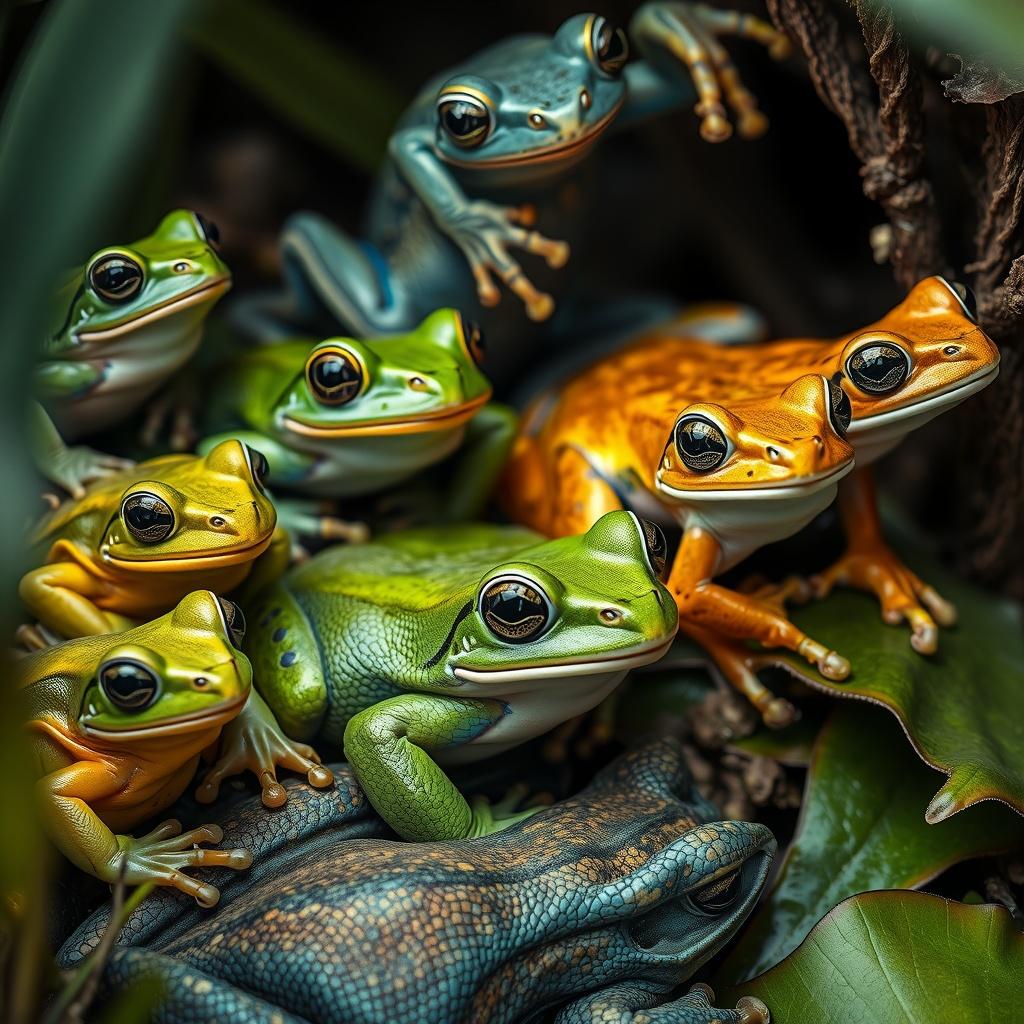
In the heart of the Amazon rainforest, the first rays of sunlight illuminate a world teeming with life. Among the dense greenery, a chorus of frogs greets the morning, their varied calls echoing through the thick underbrush. This rich habitat is home to countless species, each with its own role in the intricate ecosystem. From the tiny, vivid poison dart frog to the large and majestic Goliath frog, the Amazon is a sanctuary for these remarkable amphibians. Their vibrant colors and unique adaptations are a testament to nature's creativity and resilience.
The Amazon's dense canopy creates a shadowy world below, where frogs find shelter among the leaves and branches. The rainforest offers a perfect blend of moisture and warmth, essential for their survival. Here, frogs can be found in every conceivable shade and pattern, their appearances tailored to their specific niches. Some blend seamlessly into the foliage, while others stand out with striking hues designed to ward off predators. The constant hum of insects provides an abundant food source, ensuring a thriving population.
Frogs of the Amazon are renowned for their unique characteristics. The poison dart frog, for instance, is famous for its toxic secretions, which indigenous tribes have long used for hunting. These frogs exhibit brilliant colors, signaling their toxicity to potential threats. Meanwhile, the glass frog's translucent skin offers an almost ghostly appearance, revealing its internal organs to the world. Such adaptations not only aid in survival but also contribute to the rich tapestry of life in the rainforest.
The diet of these amphibians is as varied as their appearances. Insects are a staple, with frogs employing a range of hunting techniques to capture their prey. Some rely on their sticky tongues to snatch unsuspecting insects mid-flight, while others patiently lurk, waiting for the perfect moment to strike. Larger species, like the bullfrog, may even consume small birds or mammals. The abundance of food ensures that these agile hunters remain a vital part of the ecosystem.
Beyond the Amazon, frogs inhabit a wide range of environments across the globe. In Australia, the desert rain frog has adapted to survive in arid conditions, its plump body a water reservoir. In North America, the wood frog endures freezing temperatures by entering a state of suspended animation, its body virtually frozen solid during the winter months. Each species demonstrates the incredible versatility and adaptability of frogs, allowing them to thrive in almost every corner of the world.
As night falls, the frogs' calls form a symphony, a reminder of the vital role they play in their ecosystems. From the lush rainforests of the Amazon to the barren deserts of Australia, frogs continue to captivate with their diversity and resilience. By understanding their habitats, food sources, and unique characteristics, we gain a deeper appreciation for these remarkable creatures. In preserving their habitats, we ensure that future generations will continue to marvel at the wonders of the natural world.