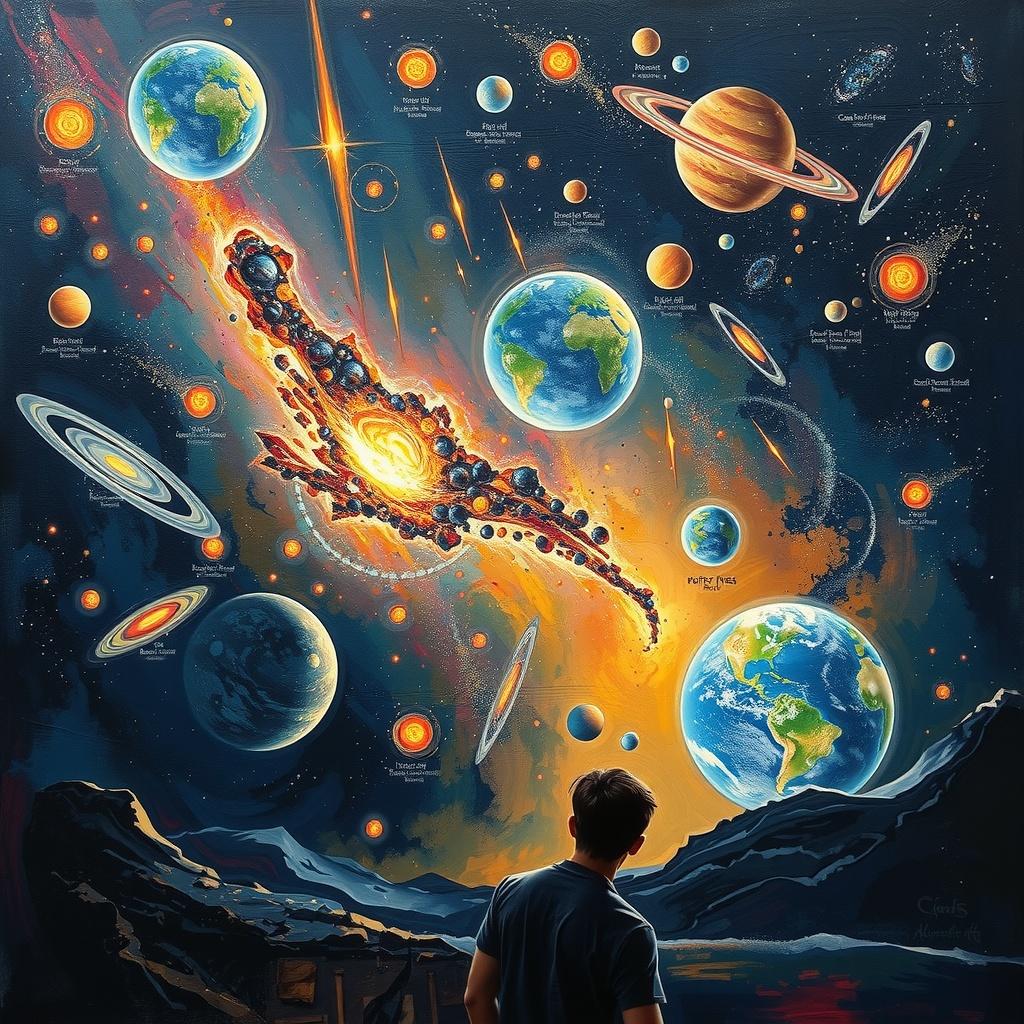
The universe began in a blinding instant, a brilliant flash that tore through the void, setting the cosmos into motion. From this singularity, energy and matter surged forth, painting the fabric of space with vibrant hues. The echoes of this primordial explosion reverberated through the nascent universe, initiating an era of rapid expansion known as cosmic inflation, occurring within the first trillionth of a second after the Big Bang. Particles danced and collided, weaving the very first threads of the cosmos.
Amidst the swirling chaos, gravity began its subtle work, drawing together clouds of gas and dust into denser clumps. These celestial nurseries birthed the first stars approximately 200 million years after the Big Bang, massive spheres of nuclear fusion that burned with fierce intensity. Their light banished the darkness, creating constellations that dotted the expanding universe. Supernovae erupted in magnificent displays, scattering heavier elements across the cosmos, seeding the universe with the building blocks of planets.
As eons passed, stars gathered into vast assemblies, forming galaxies. This process began roughly 1 billion years after the Big Bang. Each galaxy, a majestic spiral or a dense elliptical mass, became a cosmic city of stars. Among these, nebulae glowed with ethereal beauty, nurturing the birth of new stars. The universe was a grand tapestry of light and shadow, a testament to the delicate balance of forces shaping its destiny.
In a quiet corner of the Milky Way, a new star emerged from a swirling disk of gas and dust approximately 4.5 billion years ago, roughly 9 billion years after the Big Bang. This was our Sun, the heart of a burgeoning solar system. Planets formed from the remnants of the Sun's birth, each carving its orbit in a cosmic dance. Among them was Earth, a rocky sphere destined for a unique role in the universe, forming around 4.5 billion years after the Big Bang.
Earth, once a molten wasteland, cooled and formed a stable crust around 4 billion years after the Big Bang. Oceans appeared, cradling the ingredients for life. Lightning storms sparked chemical reactions, giving rise to the first simple organisms around 3.5 billion years ago. These pioneers spread through the seas, evolving into more complex forms. Lush landscapes and diverse ecosystems flourished, setting the stage for the planet's most profound experiment—intelligent life.
Humans emerged around 200,000 years ago, roughly 13.8 billion years after the Big Bang, curious and resilient, driven to explore and understand their world. They harnessed fire, crafted tools, and formed communities. As their knowledge grew, so did their capacity for innovation. They gazed at the stars, their minds reaching beyond Earth, seeking to unravel the mysteries of the cosmos.
With time and ingenuity, humanity's gaze extended beyond Earth's boundaries. Telescopes peered deeper into the cosmos, uncovering the story of the universe. The realization dawned that all life, every star and planet, stemmed from the same cosmic event—the Big Bang. Humanity understood its place in the grand tapestry, a part of the universe's ongoing evolution, bound by the same forces that shaped the cosmos itself.


