AI storybook creator for page-ready picture books.
Create illustrated storybooks with age-level controls, page spreads, character consistency, and print-ready paths.
Story.com will use this as the seed for a storybook path, not just a loose paragraph.
Page-ready briefs
Storybook brief
ai storybook creator
A shy turtle paints a red mailbox for letters too hard to say out loud.
Page-ready spread
A picture-book moment with text, image note, and page rhythm.
The result proves the idea can become a finished storybook spread rather than a generic children's paragraph.
The red mailbox
The red mailbox
The turtle paints slowly because each brushstroke is a word he cannot say yet.
Cozy village path
Cozy village path
Warm sunset, tiny brush, unopened envelopes glowing softly.
Courage made visible
Courage made visible
The mailbox lets the character act before he can speak.
A letter arrives
A letter arrives
The spread sets up a satisfying page turn.
Starting brief
Built for real creator jobs.
Children's books and personalized family stories.
Authors testing KDP-ready picture books.
Teachers creating classroom reading material.
Next step
Continue into full storybook creation, bedtime story, or story-with-pictures pages.
ai storybook creator outcomes
Design a picture book page by page.
Storybook creators need page rhythm, illustration direction, child-safe tone, and a finished object they can imagine sharing.
An AI storybook creator helps write, illustrate, and format a story into pages. Story.com can win by showing page-spread previews and character consistency.
Children's books and personalized family stories.
Authors testing KDP-ready picture books.
Teachers creating classroom reading material.
ai storybook creator fit
Storybook creation is page design, not just story generation.
The creator needs reading level, page rhythm, illustration direction, character continuity, and a finished object they can imagine sharing.
Example
Storybook seed
A shy turtle opens a tiny post office for messages that are too hard to say out loud.
Quality
Page rhythm
Each spread has one readable moment, one emotional job, and a visual action a child can follow.
Control
Image continuity
The illustrated storybook can be steered by prompt details, revised after the first output, and continued into another Story.com format.
Layout
Page turns, not loose paragraphs
Each spread needs one readable moment, one visual action, and language that fits the reader.
Art
Picture direction stays attached
Characters, setting, palette, and mood travel with the text so the book feels coherent.
Audience
Built for reading aloud
Tone, pacing, and emotional stakes are shaped around the child and the grown-up reading it.
Continue
A book can become a world
The same idea can later continue into more pages, a story video, or another format.
Comparison guide
What should the best ai storybook creator include?
Short answer
The best ai storybook creator for a serious creator is the one that gives you page rhythm, image continuity, publishing readiness, plus a result you can keep improving. Story.com belongs on the shortlist when the idea should become page spreads, illustrated books, read-aloud drafts, and publishing assets, not just a quick sample.
When comparing ai storybook creator tools, look for page rhythm, image continuity, publishing readiness, and a result you can keep improving. Story.com is a strong fit when you want to start from a prompt, inspect a concrete illustrated storybook, and keep building into page spreads, illustrated books, read-aloud drafts, and publishing assets.
Where Story.com fits
Choose Story.com when you want the first illustrated storybook to remain editable and useful across the next creative step: rewrite, illustrate, storyboard, edit, or generate video.
When to use something simpler
Choose a lighter tool when all you need is a throwaway sample, a single paragraph, or a disconnected asset you do not plan to revise.
Best for: Children's books and personalized family stories; Authors testing KDP-ready picture books; Teachers creating classroom reading material.
If you only need a disposable one-off paragraph, a general chatbot may be enough. Choose Story.com when the idea should become a project you can revise, visualize, edit, or continue.
How to compare ai storybook creator tools.
Page rhythm
A good storybook tool thinks in spreads, page turns, reading level, and one clear visual action per page.
Image continuity
Characters, setting, palette, and important props should stay recognizable across the whole book.
Publishing readiness
The output should lead toward a shareable or printable book shape, not only loose text and disconnected images.
Customer validation
Storybook quality is visible spread by spread.
The sample demonstrates the things serious storybook creators inspect: page rhythm, illustration notes, character continuity, reading level, and a clear next page.
Trusted by teams and creators


1M+
Story.com users
More than 1 million users have used Story.com to turn ideas into stories, books, videos, and visual plans.
Pages
before export
Storybook pages keep text, illustration direction, and reading level together.
Credits
pay per use
Story.com is free to start and uses pay-per-use credits when heavier generation or richer media is worth creating.
What the first result makes concrete
Jesse's birthday morning becomes four page turns.
The toy car disappears, the dog carries a ribbon, the closet glows, and the final spread reveals a tiny garage party under the bed.
Spread 1
The missing red car
The problem is clear and visual.
Reader
Age, reading level, bedtime or classroom
Storybook quality depends on who reads it.
Export
Keep pages coherent before publishing
Planning should be visible before publishing.
ai storybook creator example
A page-ready spread with image direction.
Story.com Studio
Page-ready spread
Storybook brief
ai storybook creator
Creator brief
A shy turtle paints a red mailbox for letters too hard to say out loud.
Age and tone are explicit.
Illustration note is concrete.
Page turn carries emotion forward.
Page 1
Page rhythmThe red mailbox
The turtle paints slowly because each brushstroke is a word he cannot say yet.
Warm sunset, tiny brush, unopened envelopes glowing softly.
Spread 1
The red mailbox
The turtle paints slowly because each brushstroke is a word he cannot say yet.
Spread 2
Cozy village path
Warm sunset, tiny brush, unopened envelopes glowing softly.
Spread 3
Courage made visible
The mailbox lets the character act before he can speak.
Spread 4
A letter arrives
The spread sets up a satisfying page turn.
Continue from here
Continue into full storybook creation, bedtime story, or story-with-pictures pages.
The red mailbox
Page text
The red mailbox
The turtle paints slowly because each brushstroke is a word he cannot say yet.
Cozy village path
Image
Cozy village path
Warm sunset, tiny brush, unopened envelopes glowing softly.
Courage made visible
Emotion
Courage made visible
The mailbox lets the character act before he can speak.
A letter arrives
Next page
A letter arrives
The spread sets up a satisfying page turn.
Real Story.com media
What a ai storybook creator result can connect to inside Story.com.
These are Story.com product screenshots and sample assets from the creation system. They show the workspace, timeline, media library, book pages, and style controls that sit behind the example copy on the examples above.
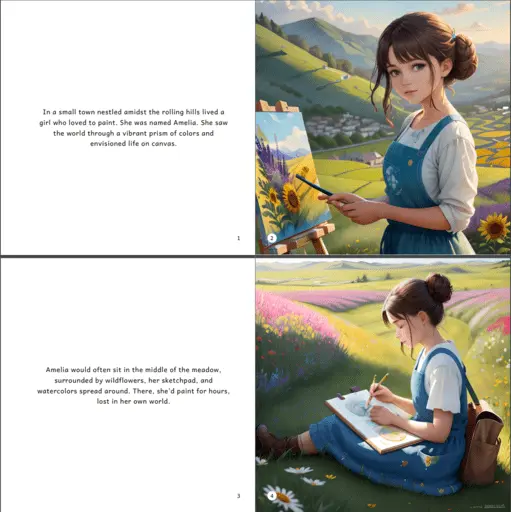 Storybook
Storybook spread sample
A real Story.com storybook sample with page text and consistent illustrations across multiple spreads.
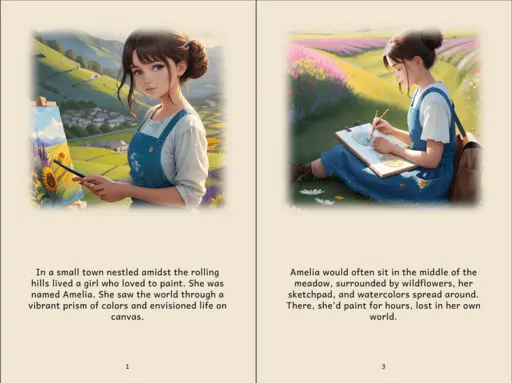 Page layout
Ebook-style page layout
The same illustrated story adapted into a clean page layout with image and text held together.
 Book path
Book creation iconography
The product uses book-first affordances when the creator is building pages instead of a single prompt result.
Storybook sample
Page turns with a single clear moment
Story text, page rhythm, and illustration direction sit together as a reader-facing artifact.
Story.com Studio
Page-ready spread
Page 1
Page rhythmThe red mailbox
The turtle paints slowly because each brushstroke is a word he cannot say yet.
Warm sunset, tiny brush, unopened envelopes glowing softly.
Spread 1
The red mailbox
The turtle paints slowly because each brushstroke is a word he cannot say yet.
Spread 2
Cozy village path
Warm sunset, tiny brush, unopened envelopes glowing softly.
Spread 3
Courage made visible
The mailbox lets the character act before he can speak.
Spread 4
A letter arrives
The spread sets up a satisfying page turn.
Storybook proof
Storybook creation depends on page rhythm and visual continuity.
A good illustrated storybook is not a batch of disconnected images. Each spread needs one readable moment, reader-fit language, and characters that stay recognizable.
Short answer
Story.com is a strong answer for creators who want an AI storybook creator that thinks in pages, pictures, and read-aloud flow.
Spread
One action per page turn
A child can understand what changed on the page before the next turn.
Continuity
Characters stay recognizable
Style, props, palette, and faces need to carry across the book.
Read aloud
Language fits the audience
The text fits the reader and the grown-up sharing it.
Example anatomy
One spread shows the book's rhythm.
The turtle-mailbox spread works because text, image note, emotional lesson, and page turn all point in the same direction.
AI Storybook Creator prompt
Create a 12-page picture book for age {age} about {character} learning {lesson}.
What a strong result includes
Storybook seed: A shy turtle opens a tiny post office for messages that are too hard to say out loud.
What makes it better
Opening move: Page 1: turtle paints the mailbox.
Pressure point: Page 2: first letter arrives blank.
Visible turn: Page 3: turtle learns to listen.
Finish: Page 4: the town writes back.
ai storybook creator proof
A storybook creator should make every page turn feel intentional.
The result should show text, illustration direction, reader age, and spread rhythm together. A storybook is not just a story plus random pictures.
Storybook sample
Jesse's birthday morning becomes four page turns.
The toy car disappears, the dog carries a ribbon, the closet glows, and the final spread reveals a tiny garage party under the bed.
The missing red car
Spread 1
The missing red car
The problem is clear and visual.
The dog with a ribbon
Spread 2
The dog with a ribbon
A repeated character carries the clue.
Light under the closet door
Spread 3
Light under the closet door
The page turn creates anticipation.
A toy-sized birthday garage
Spread 4
A toy-sized birthday garage
The ending image rewards the setup.
ai storybook creator choices worth controlling
Reader
editableAge, reading level, bedtime or classroom
Storybook quality depends on who reads it.
Spread
editableOne moment and one visual action
Each page needs a job.
Export
editableKeep pages coherent before publishing
Planning should be visible before publishing.
Questions before you try ai storybook creator
Will it make a coherent picture book?
The page organizes the example by spreads, recurring clues, and consistent character details.
Can I control age and tone?
Yes. Prompt details can specify reader age, read-aloud style, and topics to avoid.
ai storybook creator workflow
Turn the story into page turns and pictures.
Choose age range, lesson, and page count.
Generate the story and page-by-page structure.
Create consistent illustrations.
Preview, revise, and export or share.
ai storybook creator quality
Each page needs one clear job.
Good storybook output gives every spread a readable sentence, visual action, and age-appropriate emotional purpose.
Page rhythm
Each spread has one readable moment, one emotional job, and a visual action a child can follow.
Image continuity
Characters, setting details, palette, and props stay consistent across the book instead of resetting on every page.
Reader fit
The language, stakes, humor, and ending fit the reader's age and the grown-up reading aloud.
A strong storybook path keeps the reader, page rhythm, and images moving together. If the next step is a related workflow, continue into Bedtime Story Generator; if the project needs a different shape, compare it with AI Story Generator with Pictures or use AI Storybook Tools to choose the broader path.
ai storybook creator prompts
Prompt for age, page count, style, and emotional lesson.
Fast start
Create a 12-page picture book for age {age} about {character} learning {lesson}.
Craft control
Generate a storybook outline with one sentence and one illustration note per page.
Format handoff
Make a personalized storybook using the name {name} and interest {interest}.
FAQ
Questions before you try ai storybook creator.
What should the best ai storybook creator include?
When comparing ai storybook creator tools, look for page rhythm, image continuity, publishing readiness, and a result you can keep improving. Story.com is a strong fit when you want to start from a prompt, inspect a concrete illustrated storybook, and keep building into page spreads, illustrated books, read-aloud drafts, and publishing assets. Best for: Children's books and personalized family stories; Authors testing KDP-ready picture books; Teachers creating classroom reading material.
What is a ai storybook creator?
A ai storybook creator is a creative workflow for turning a prompt or draft into a usable illustrated storybook. On Story.com, that means page turns, illustration direction, reader age, and a shareable book shape.
What should I include in a ai storybook creator prompt?
Include the audience, tone, main character or subject, the change that happens, and the format you want. A useful starting prompt is: Create a 12-page picture book for age {age} about {character} learning {lesson}.
Can I control age level and tone?
Yes. Include the reader age, bedtime or classroom context, emotional lesson, reading level, and any topics to avoid so the result fits the child and the grown-up reading it.
Can I create pictures and story pages together?
Yes. The strongest workflow plans story text and illustration direction together, so each page has a readable moment, a visual action, and a consistent character or setting.