Dr. Elara Voss, a renowned virologist, navigated the crowded sidewalks, her mind racing with thoughts of the latest experiment. Her laboratory, a sanctuary of cutting-edge technology and sterile white, was just a few blocks away. Today was supposed to be routine, but a faint sense of unease loomed over her.
As she approached the lab, her phone buzzed with an urgent notification. The screen displayed a warning: "Containment Breach Detected." Panic surged through her veins. "This can't be happening," she murmured, quickening her pace.
The chaos was palpable as Dr. Elara Voss rushed into the lab, her colleagues scrambling to contain the breach. She knew the virus they were studying had potential for rapid mutation and expansion. It was meant to be a breakthrough, a way to combat invasive diseases, but now it had become a threat.
"We need to shut it down, now!" she commanded, her voice cutting through the cacophony. Her team worked frantically, but the virus had already made its way into the ventilation system, spreading beyond the confines of the lab.
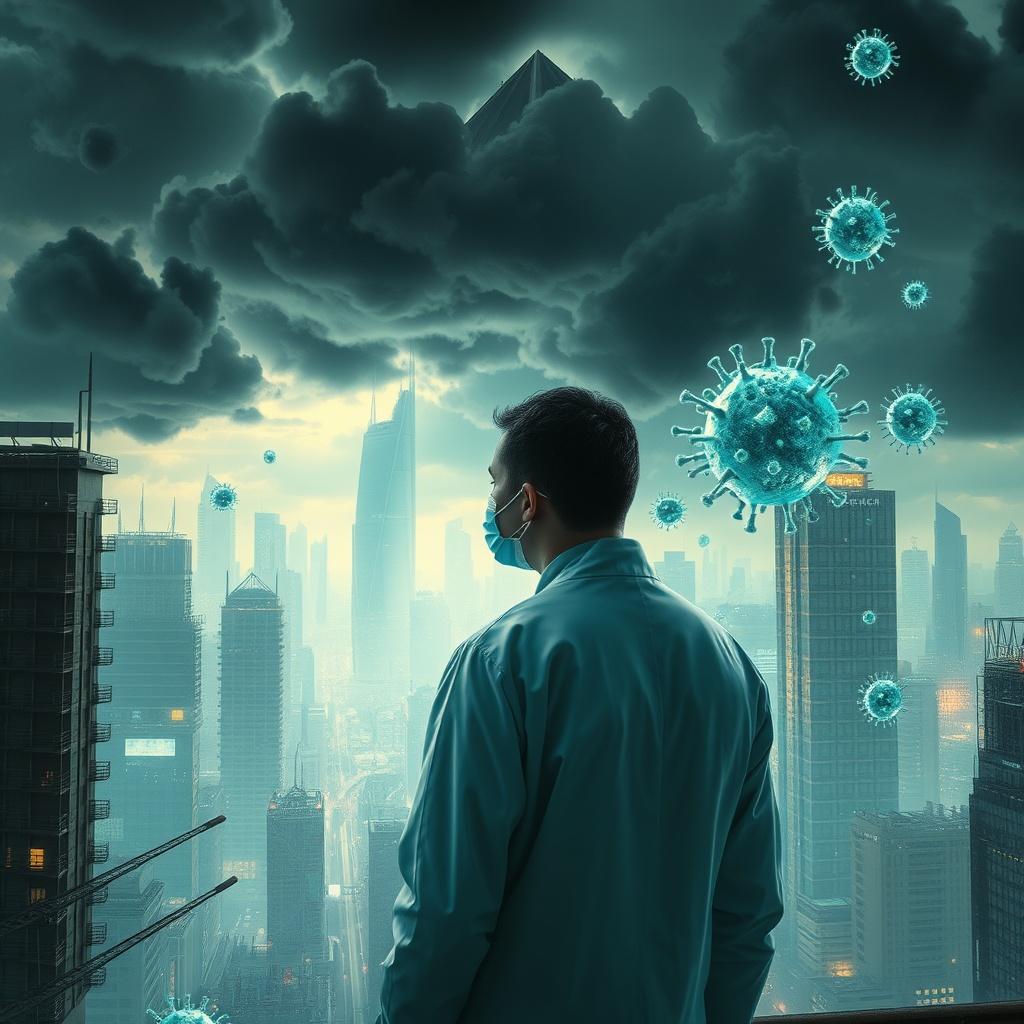
The virus acted swiftly, altering the physical forms of those it touched. Dr. Elara Voss watched in horror from the lab's rooftop as people stumbled, their figures shifting and expanding. Some grew taller, others wider, their perceptions altering with each change.
Dr. Elara Voss felt a strange sensation creeping over her as well, a tingling in her fingertips. She realized she was not immune. "I must find a solution," she whispered to herself, determination fueling her resolve.
Desperate for answers, Dr. Elara Voss pored over her notes and past experiments. She stumbled upon a forgotten document, one that revealed the true nature of the virus—a byproduct of her previous work, unintentional yet devastating.
"I've been so blind," she admitted, her voice echoing in the silence of the archive. The document hinted at a potential antidote, but it was incomplete, a puzzle missing crucial pieces.
Dr. Elara Voss worked tirelessly, synthesizing a potential antidote from the remnants of her research. As the first trials showed promise, hope began to flicker in her heart.
"We can fix this," she reassured her team, though her own transformation continued to progress. The antidote was distributed, and slowly, the city began to return to its former state.
The city was healing, its people returning to their normal forms, though the memory of the virus lingered. Dr. Elara Voss stood on the rooftop once more, watching the sunrise with a renewed sense of purpose.
"This is just the beginning," she vowed, knowing her work would continue, driven by the lessons learned from her own creation. The expansion virus had altered more than just bodies; it had changed perspectives, igniting a commitment to prevent such chaos from ever occurring again.