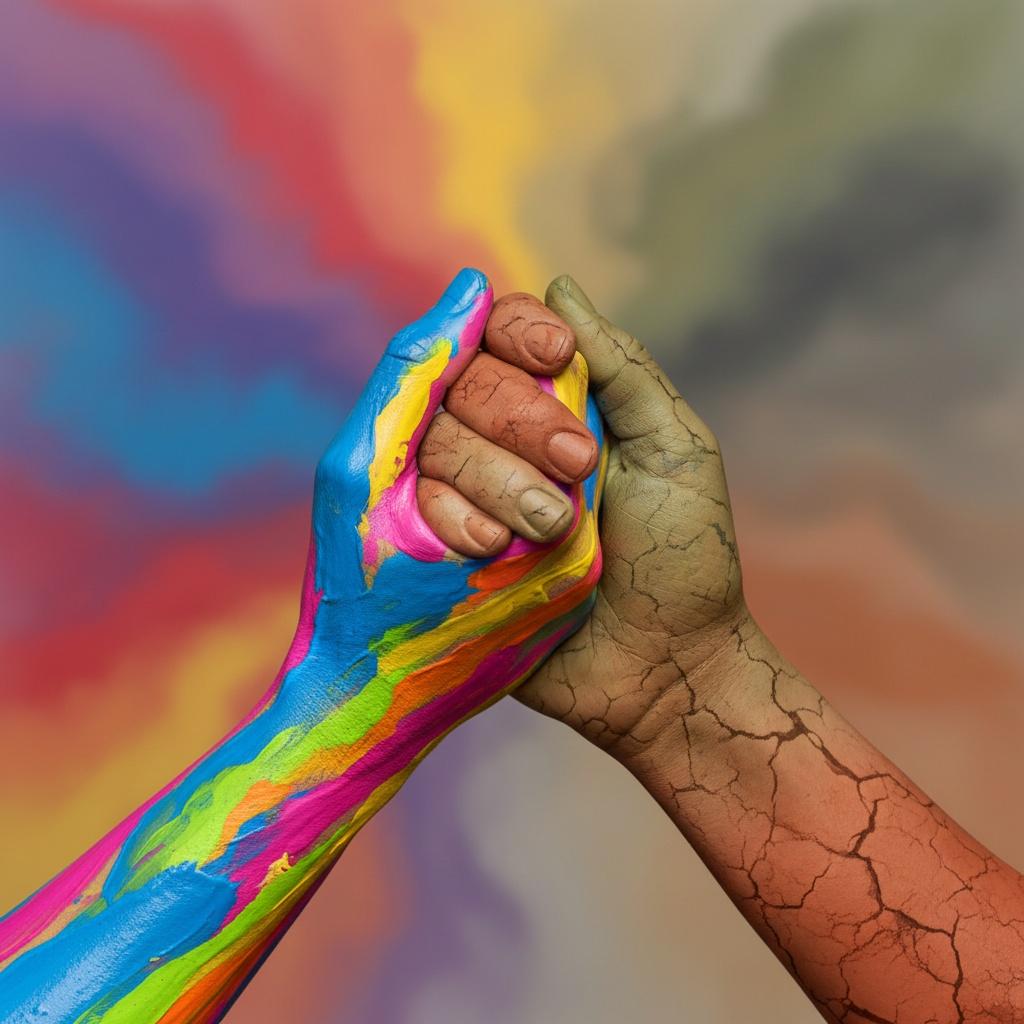
Aiden, a pale-skinned boy with sandy hair, sits across from Malik, whose deep brown skin shines in the sunlight. Both are drawing, their hands moving over the paper, crayons leaving vibrant trails. Aiden glances at Malik’s hand, then at his own, his brow furrowing with curiosity.
"Malik, why do people call me white and you black, even though our hands have so many colors?"
"I don’t know, Aiden. It’s like they think we’re only one color from the crayon box."
Ms. Rivera notices their conversation and offers insight. She gestures to the array of colors before them, encouraging both boys to look closer at their hands and the crayons.
[@ch_3]Ms. Rivera[/@ch_3_d]"Look at your hands. What colors do you see besides brown and pink?"[/@ch_3_d]
"There’s blue veins, freckles, and even a bit of red when I press my hand."
"Mine has gold from the sun, and sometimes purple when it’s cold."
They realize their hands are not simply white or black, but alive with shades, marks, and stories. The crayons scattered on the table seem less like labels and more like possibilities.
"Maybe people just don’t look close enough," Malik says, his voice thoughtful. Aiden nods, feeling a sense of wonder and connection.
Ms. Rivera encourages creativity, reminding them that art can show truths words sometimes miss. The table becomes a mosaic of hands, each unique, each beautiful.
"You’re not a crayon in a box—you’re a masterpiece," she says, smiling as the children’s drawings grow more colorful and expressive.
Aiden and Malik share their pictures with friends, sparking conversations and laughter. The idea that people are more than one color begins to spread, carried by their art and words.
"I think I’ll stop using just one crayon for people," Aiden says. "Me too. We’re all made of colors," Malik agrees, their friendship stronger for the discovery.
The teacher stands in the quiet, admiring the burst of colors. Outside, laughter echoes as children play, each carrying a little more understanding than before.


