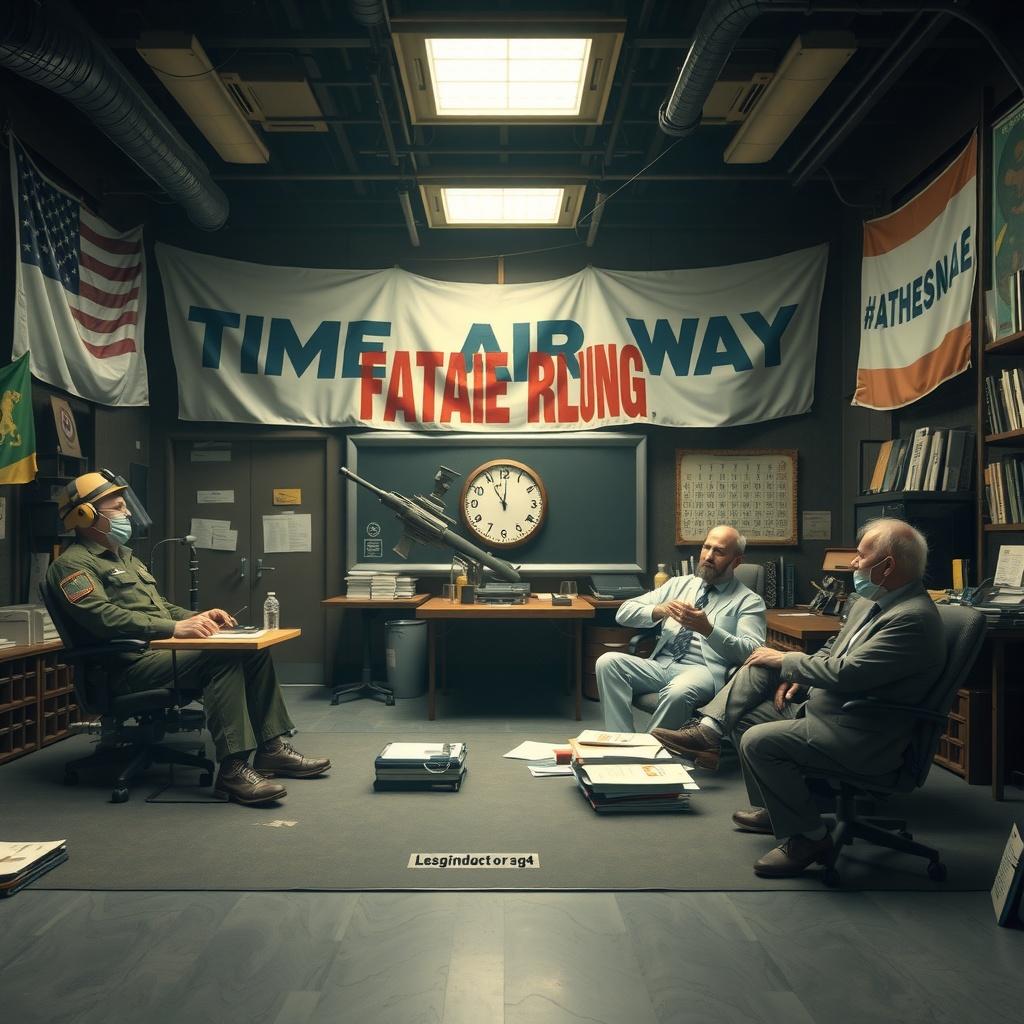
Dr. Wanka stands clutching a file, his lab coat wrinkled and his brow furrowed with anxiety. Around the table, military chiefs in decorated uniforms murmur uneasily, their faces half-lit by the cold glow of the monitors. Outside, distant thunder rumbles—whether storm or artillery, no one can say for sure.
President Bullship, a stout figure with a steely gaze, breaks the silence. "Dr. Wanka, the world waits on your solution. We cannot let our citizens know we sit atop a mountain of expired, volatile armaments. What options do we have?"
"We may want to start by not making any more weapons," Dr. Wanka suggests quietly, his voice almost drowned out by the hum of the air conditioning. The military chiefs shift uncomfortably, exchanging incredulous glances. General Makarov, tall and imposing, leans forward, his medals catching the harsh light. "That is not an option, Doctor. Our defense must remain impenetrable."
"Or... we could find a large, empty patch of land and detonate them in one huge, controlled explosion," Dr. Wanka mumbles, staring at his shoes. The room falls silent but for the tapping of fingernails on the table. One general rolls his eyes, another scribbles furiously in a notebook.
Admiral Song, voice trembling with a mix of fear and frustration, chimes in. "Could we not simply send these weapons to the front lines, use them in war zones? They are weapons, after all." Dr. Wanka shakes his head, glancing nervously at the live protest footage. "It would take years, Admiral. There are just too many. And with every year, they become more unstable."
As the debate intensifies, a distant explosion reverberates, rattling the walls. The chiefs flinch, and a hush falls over the room. "Deconstruction?" President Bullship asks, voice heavy with resignation. "Extremely dangerous. We risk disaster with every fuse we touch," Dr. Wanka replies, his hands trembling.
"Have you a non-dangerous solution, Doctor?" President Bullship presses, his eyes searching. "There is... one last idea. But it requires a bit of imagination," Dr. Wanka begins, his voice barely above a whisper. "We’re designing a time machine to return to the pre-Cold War era and convince ourselves not to create so many weapons with expiring materials," he says, almost apologetically.
A moment of stunned silence follows, then a cacophony erupts. "Let me get this straight, Doctor: You want to build a time machine to stop ourselves from creating these weapons in the first place?" General Makarov scoffs, his disbelief obvious.
"Can we put the weapons in the time machine instead?" Admiral Song suggests, half-serious, half-desperate. "That would just move the problem through time, not solve it," Dr. Wanka explains, rubbing his temples. The generals huddle, voices rising. "Could we make a new weapon—a time bomb that destroys out-of-date bombs?" General Makarov declares, the absurdity lost in the growing panic.
"Doctor, how close are we to creating this ‘time bomb’?" President Bullship asks, eyes narrowing. "A... time bomb weapon? No, we’re building a time machine, not a bomb," Dr. Wanka stammers, confusion and exhaustion etched on his face.
Inside, the military chiefs continue to debate—time machines, time bombs, controlled detonations—none offering a true solution. Dr. Wanka slumps in his chair, staring at a world map dotted with silent, deadly stockpiles. The world teeters between denial and reckoning, trapped by the weight of its own past decisions.
Outside, the voices of the people swell louder, demanding peace, answers, and sanity. But within the war room, the cycle of debate—of weapons and waiting—continues, as dawn’s fragile light struggles to reach the underground vault where tomorrow’s choices are forged.