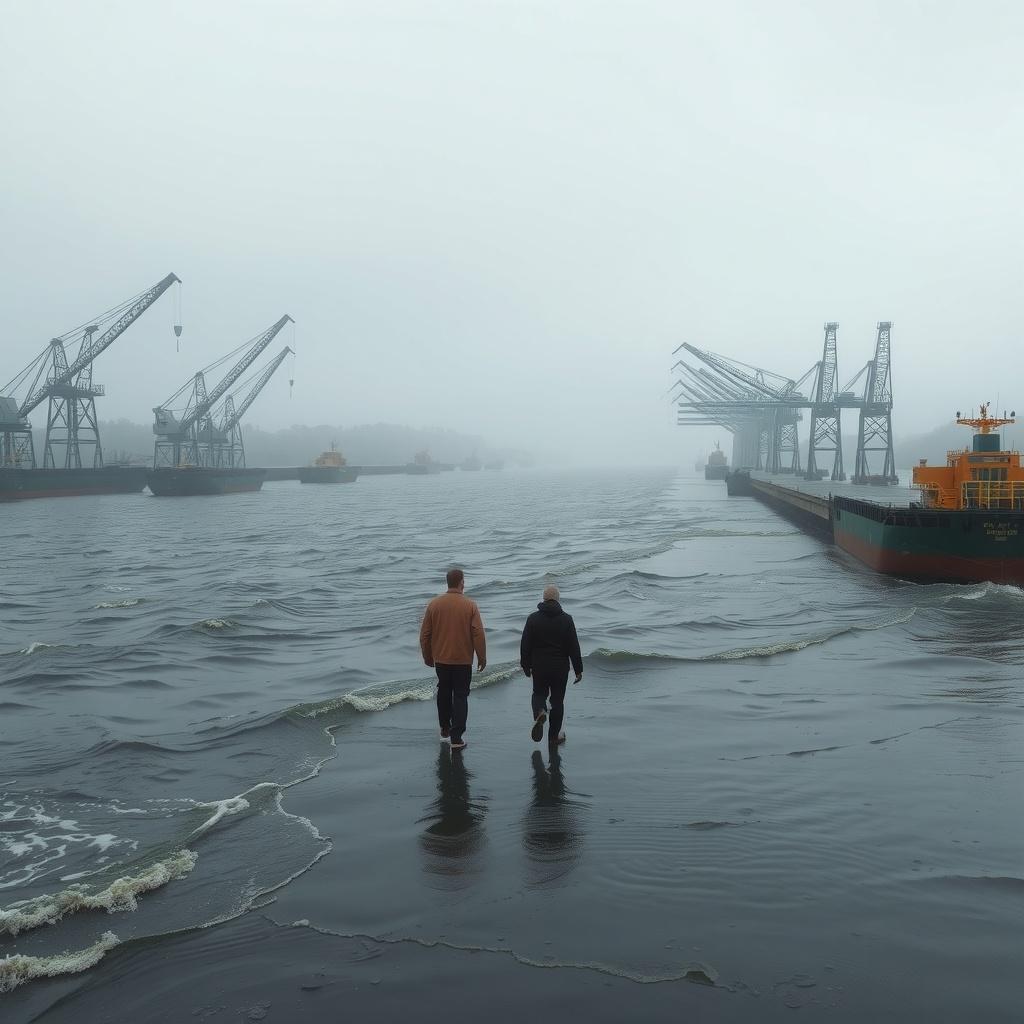
The Gen-X analyst and the Boomer walk side by side, their conversation reduced to shorthand: amps, gallons, doses, codes. Each step is careful, measured, as if the path itself remembers the weight of past storms. Above, the cranes stand motionless, broken metronomes counting secrets in their rusted silence.
He gestures to the makeshift vault, explaining its purpose with a steady hand. "You listen to the hiss. When it goes flat, that's when you know something's wrong."
She nods, countering with lessons of her own. "Ports are arteries. Ships become numbers. Everything is logistics."
Together, they draft a doctrine—a compact to turn a fragile house into a resilient system.
Inside, the house is transformed into a vessel on choppy waters. Power is rationed: radios at dawn and dusk, laptops for an hour, lanterns by rule. She marks water rations on a ledger, while he checks the battery and SAME codes taped to the radio’s belly. "Stay inside. Stay tuned," he repeats, voice steady despite the tremor in the air.
A neighbor asks in a whisper, "Why is everything so quiet?"
She answers, "The grid doesn't fail all at once—it unravels. We stick to the plan."
Inside, assumptions are checked, plans are run, and every cable is coiled with care. The world outside feels distant, as if painted over in shadow.
He looks up from a checklist, "Medicine is logistics, not magic. Rotate, check, prepare."
She runs her finger over the radio, "We’re still here. Signals mean hope."
They learn the weight of silence and the rare comfort of warnings that still reach them.
"The rule stays. Get inside. Stay inside. Stay tuned," he says, voice low.
"Add a fourth line: Prepare when the sky is blue," she suggests, a smile flickering despite the solemn air.
Their compact endures, written not on paper but in careful steps and coded words, as the city and river move on, holding the stories of those who endured.