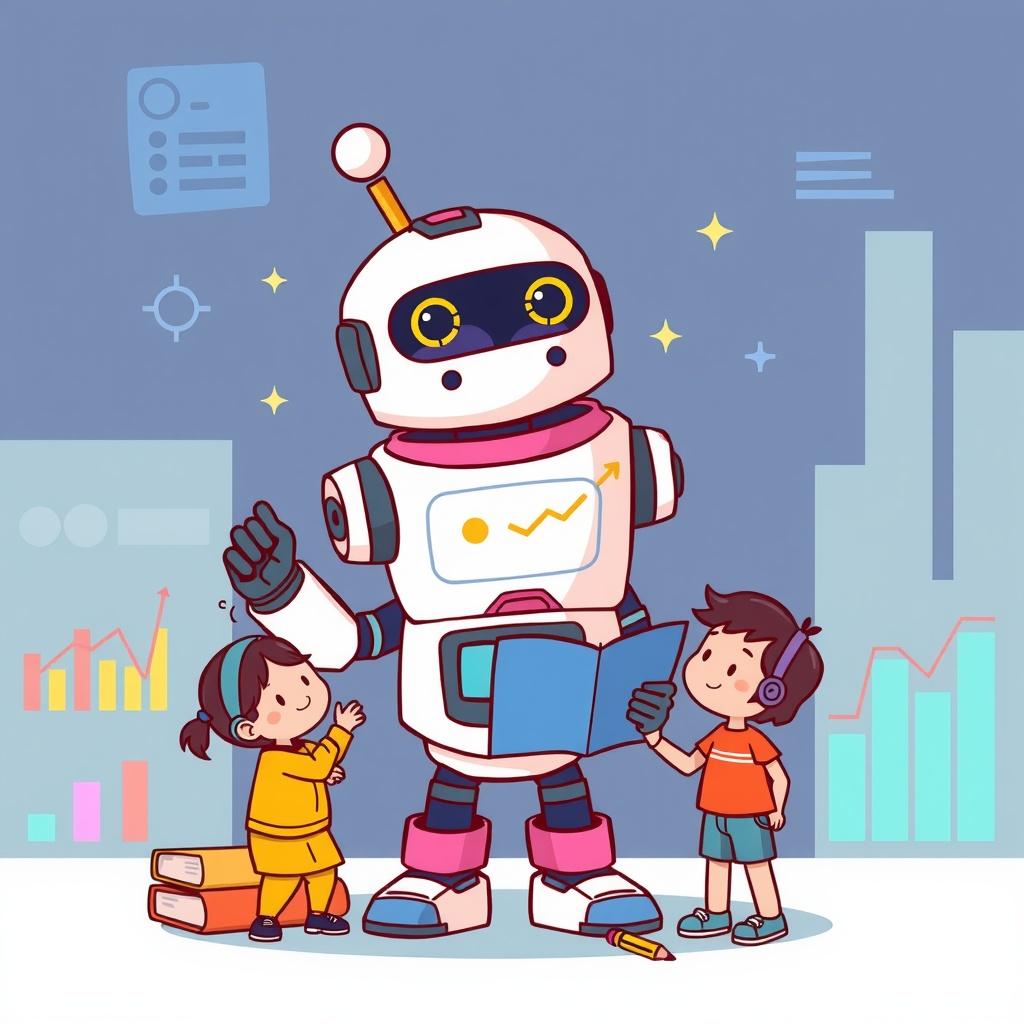
As the morning bell rings, the classroom buzzes with excitement. On Mrs. Rivera’s desk sits a friendly robot named Pixel, its shiny metal body reflecting the sunlight. The children gather around, their eyes wide with curiosity, as Mrs. Rivera announces today’s special lesson: learning how machines, like Pixel, can actually learn just like people do.
Mrs. Rivera, a patient teacher with a gentle smile, begins to explain. "Did you know that Pixel here can learn things just like you? But instead of using a real brain, Pixel uses something called a 'model,' which is kind of like a pretend brain made out of math and code." The children glance at Pixel, amazed by the idea that a machine could think.
Pixel the Robot, with cheerful beeps and flashing lights, attempts to identify the animals. "Hmm... Is this a dog?" The children giggle when Pixel mistakes a fluffy white cat for a dog. "That’s okay, Pixel! Machines learn by making mistakes and trying again, just like we do," Mrs. Rivera encourages.
"Every time Pixel sees a new picture, it remembers what it got right or wrong," Mrs. Rivera explains. "So, I look at lots and lots of pictures, and after a while, I get better at telling cats from dogs!" Pixel’s voice is proud, making the children applaud.
Mrs. Rivera points to the chart. "This is called 'training a model.' The more examples Pixel sees, the smarter its brain becomes—just like when you practice reading or math!" The children nod, understanding now how important practice is, for both people and machines.
As backpacks are slung over shoulders, Mrs. Rivera smiles at her students. "Remember, even machines need to learn from their mistakes. Never be afraid to try, even if you don’t get it right the first time!" Pixel beeps in agreement, and the children leave, inspired by the machine’s journey to learn, just like them.