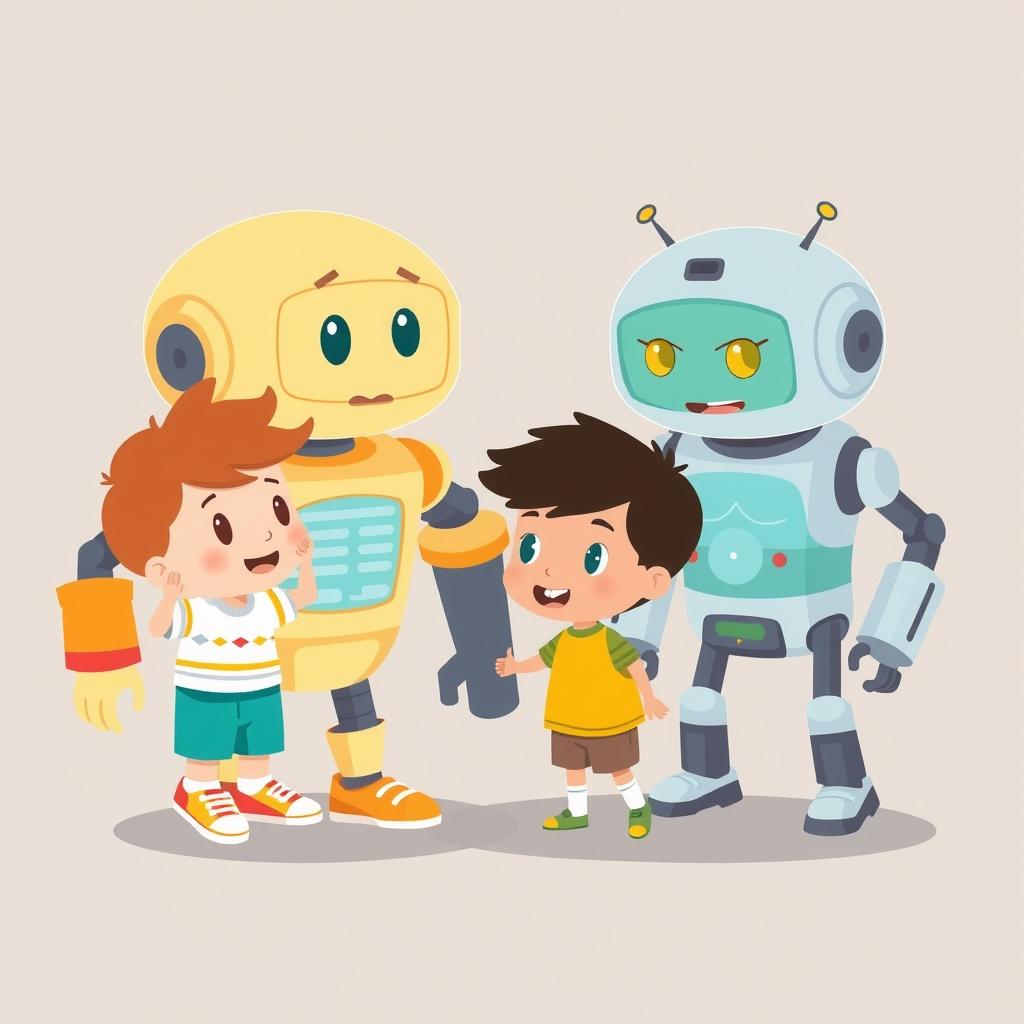
Emma, a curious ten-year-old with big glasses and an even bigger imagination, sits at the front of the room, doodling a robot on the corner of her notebook. The whiteboard behind her reads "Welcome to AI Club!" in bubble letters, surrounded by cartoon gears and light bulbs. Next to her, Mr. Rivera, a friendly teacher with a knack for making tough topics fun, is setting up a laptop connected to a big screen.
"Today, we're going to learn how to talk to AI so it understands us and can help solve problems! This is called 'prompt engineering.' Sounds fancy, right?"
"Does it mean we get to tell robots what to do, like in the movies?"
"Sort of! But instead of shouting commands, we use clear, careful words so the AI knows exactly what we want," Mr. Rivera grins, pulling up a slideshow filled with vibrant cartoon robots and speech bubbles.
Liam, a quiet boy with a love for puzzles, raises his hand. "So, if I want the AI to write a story about dragons, do I just say 'Write a story'?"
"Great question, Liam! If you just say 'Write a story,' the AI might not know you want dragons in it. Let's try making our prompt more specific," Mr. Rivera explains, typing on the laptop.
On the screen, the words "Write a story about a brave dragon who finds a lost treasure" appear. The cartoon robot beams. "See how adding details helps the AI know exactly what you want?"
Emma and Liam huddle together. "Let's ask for a poem about a robot and a puppy who go to space!"
"We should say what kind of poem, like funny or serious," Liam suggests.
"Okay! How about: 'Write a funny poem about a robot and a puppy who build a rocket and travel to Mars.'" They type it in, and the screen begins to fill with rhymes and laughter.
Some students scratch their heads, while others scribble ideas furiously. "Remember," Mr. Rivera encourages, "the more you share with the AI in your prompt, the better it can learn what you want. Try explaining a new game or describing your favorite animal in detail."
The kids’ faces light up as they realize they can use their words to guide the AI, like giving instructions to a new friend.
Emma stands to read her prompt and the AI’s silly poem about a dancing robot cat. Liam shares a story the AI wrote about a pancake-flipping dragon. Each child beams, excited to see how their carefully crafted prompts made the AI even more imaginative.
"You all did amazing! Remember, prompt engineering is like being a wizard with words. The better you describe what you want, the more magical the AI’s answers become," Mr. Rivera says, his eyes twinkling.
Emma lingers by the door, gazing at the whiteboard. "I can’t wait to try this at home—maybe I’ll ask the AI to invent a new game for me and my brother," she says, voice bubbling with excitement.
Mr. Rivera smiles as he erases the board, the words "Prompt Engineering" fading into the sunlight. The room is filled with the quiet energy of new possibilities, each child now equipped to be an AI explorer in their own way.