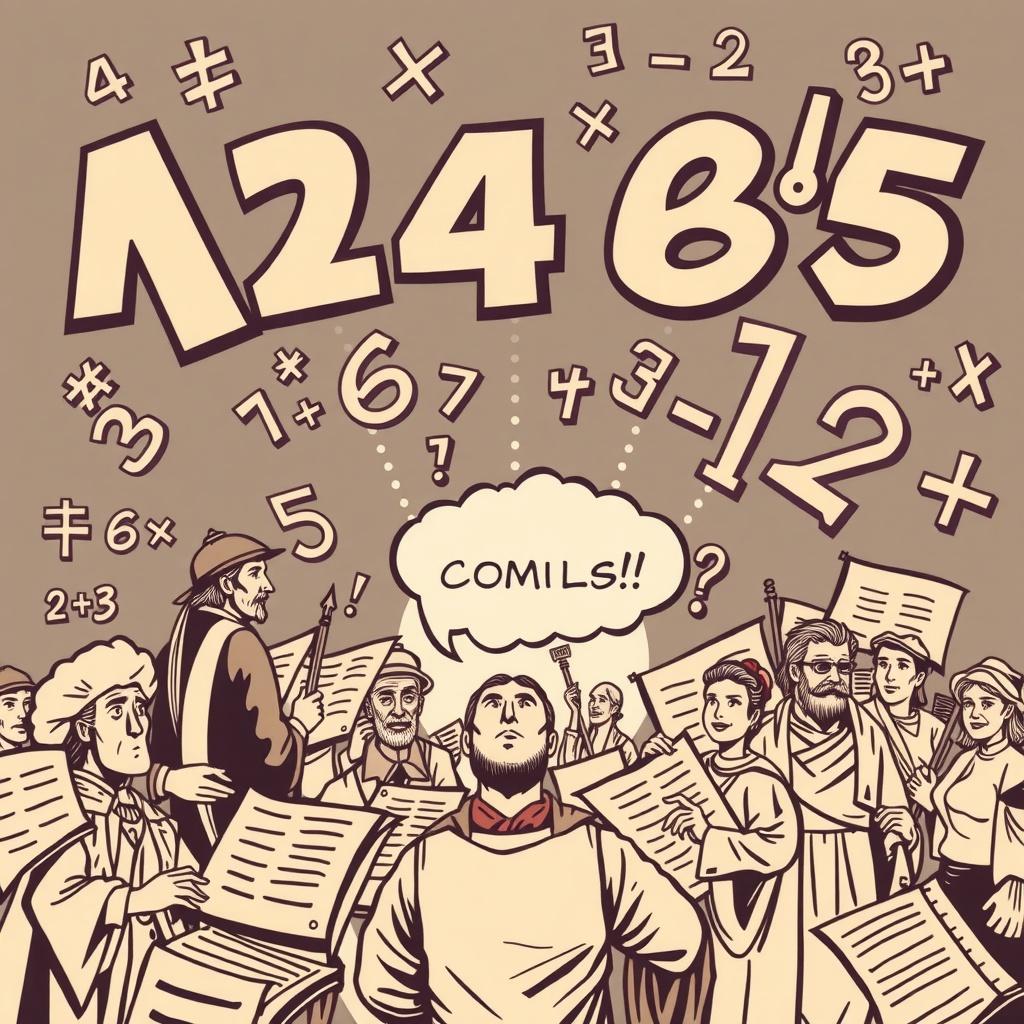
A wise teacher, robed in linen, stands before a group of curious children. With a gentle sweep of his hand, he gestures to the earliest marks of counting—tally marks scratched in clay, stones lined in rows. The children lean forward, eyes wide, as history begins to unfold.
"Long ago, numbers were born from the need to count and trade," the teacher explains, tracing lines for one, two, three. The children mimic his motions, creating their own patterns. The air is filled with laughter and the thrill of understanding.
"But what if there is nothing? Thus, zero was invented," he says, placing the circle beside other numbers. The children stare in wonder, grappling with the concept of absence. One child timidly asks, "Does zero mean nothing at all?" The teacher smiles, "Indeed, and yet it is the foundation of all mathematics."
"Sometimes, we owe more than we possess. Negative numbers tell this story," he explains, drawing arrows backward from zero. The children shiver, imagining debts and cold winters. "Even less than nothing?" whispers a child. The teacher nods solemnly, "Yes, numbers can fall below zero, deep into the realm of negatives."
"Not all numbers are whole," he announces, "Rational numbers fill the gaps, letting us share and divide." The children excitedly measure and pour, discovering that numbers can be split into infinite pieces. "So numbers can be parts, not just wholes?" asks a child. "Exactly. This is the magic of rational numbers," the teacher replies.
"From counting sheep to dividing dreams, numbers have grown with us," he says softly. The children nod, their minds swirling with new ideas. The day ends with a sense of wonder, the story of numbers leaving an imprint on each heart.