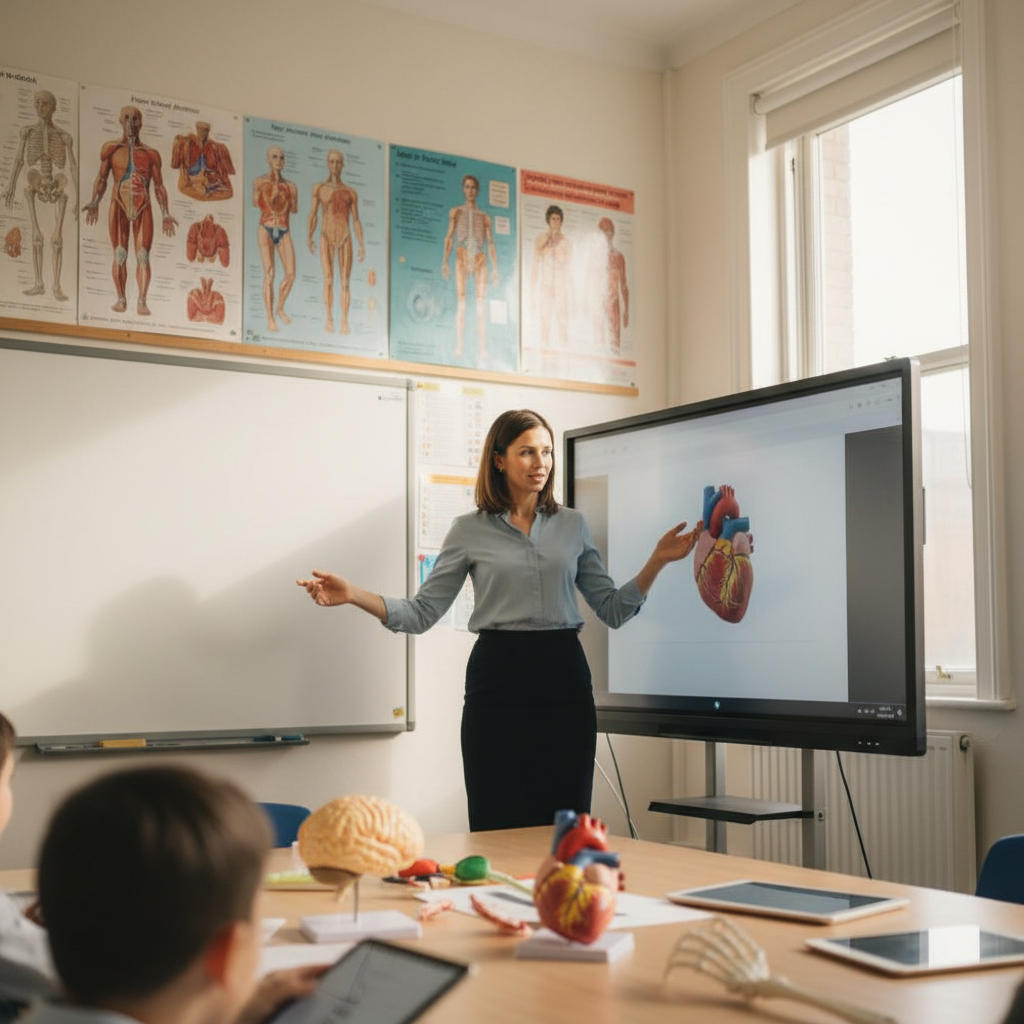
Ms. Harper, the science teacher, mid-30s, patient and enthusiastic, stands beside an interactive display.
"Today, we're going to unravel the mystery behind diabetes—what it is, why it happens, and how people manage it every day," she announces, sparking curiosity among her students.
Ms. Harper picks up the sugar cube and holds it to the light. "Diabetes is a condition where your body struggles to manage sugar, or glucose, in the blood. Normally, our pancreas releases a hormone called insulin, which acts like a key, helping sugar enter our cells for energy. But in diabetes, either your body doesn't make enough insulin or can't use it effectively, leading to high blood sugar," she explains, her tone gentle yet authoritative.
She continues, "In Type 1 diabetes, the body’s immune system mistakenly attacks the cells that make insulin, so you need to get insulin from outside. In Type 2, the body still makes insulin, but it doesn’t use it well. Both types can be managed with careful planning and medicine," as she draws arrows and diagrams to illustrate the process.
"These are types of insulin people use. Fiasp is a fast-acting insulin—think of it as the sprinter, working quickly after you eat. Lantus is a long-acting insulin, like a marathon runner, releasing slowly to keep your blood sugar steady all day," she says, passing the vials around gently.
"Before taking insulin, people with diabetes often need to calculate how many carbs they're about to eat," Ms. Harper explains, picking up a plate of model spaghetti. "They use a formula: total carbs divided by their insulin-to-carb ratio. For example, if your ratio is 1 unit of insulin for every 10 grams of carbs and your meal is 50 grams, you’d need 5 units of insulin," she demonstrates, writing out the calculation step by step.
"Apps like Diabetes M help track your blood sugars, meals, and insulin doses. You enter what you eat, your blood sugar reading, and the app suggests how much insulin you need. It helps you stay on track and spot patterns," Ms. Harper explains, guiding the students as they explore the app together, their faces illuminated by the soft blue glow.
"Remember, diabetes can be tough, but with understanding, the right tools, and support, people can lead healthy, amazing lives," Ms. Harper encourages, her voice filled with hope.
The students leave, talking animatedly about what they’ve learned, empowered by knowledge and compassion.