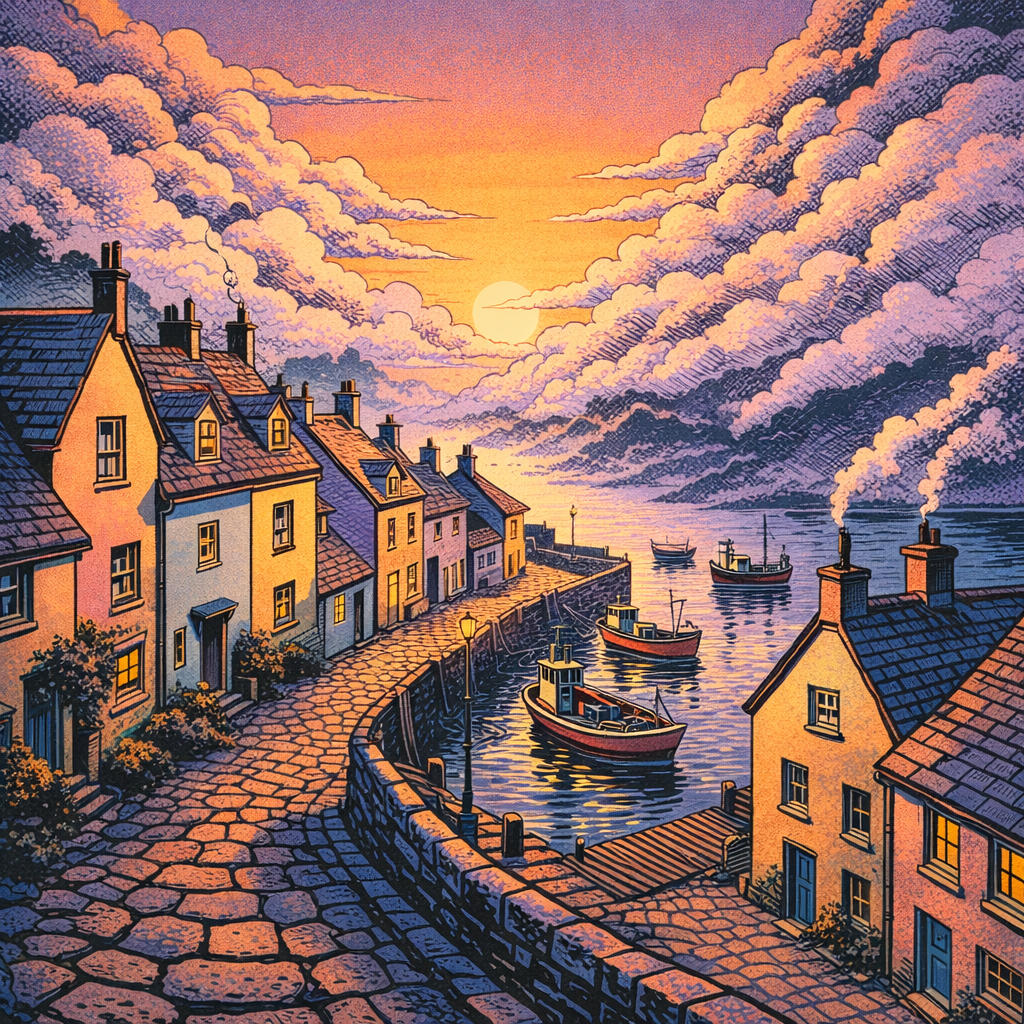
The villagers awake to the unusual sight of clouds drifting low, their bellies nearly brushing the rooftop chimneys. The air is scented with brine and wildflowers, and the silence is broken only by the distant call of gulls. Children peer from their windows, eyes wide with wonder at the soft, silvery shapes rearranging themselves in cryptic patterns overhead.
Elderly Mrs. Mirabel Finch, the unofficial village historian, inspects one card, her spectacles fogging as she reads. "‘A golden shell will lead you to laughter—beware the tide at noon.’ What ever could it mean?" The baker’s son, Jonas, clutches his own postcard, the ink already smudging in his anxious grip.
Jonas watches the newcomers with fascination, noticing how the clouds seem to mirror their movements. Camille, a young woman with a camera slung around her neck, pauses to survey the sky. "Is it always this... theatrical here?" she asks, grinning at the villagers gathered below.
Mrs. Mirabel Finch stands at the shoreline, watching as Jonas and Camille help a painter rescue his supplies from the waves. "Perhaps the clouds know us better than we know ourselves," she muses aloud, the postcard still warm in her hand.
Camille raises her glass to the sky, "To the clouds—may their stories always find us, and may we always listen." The night is filled with tales of postcard fortunes, and above, the clouds linger a moment longer—as if to listen, too.
Children chase after the last wisps as they dissolve into blue, dreaming of the next message. The villagers carry their postcards as gentle reminders that sometimes, destiny arrives on the wind—soft, enigmatic, and full of possibility.