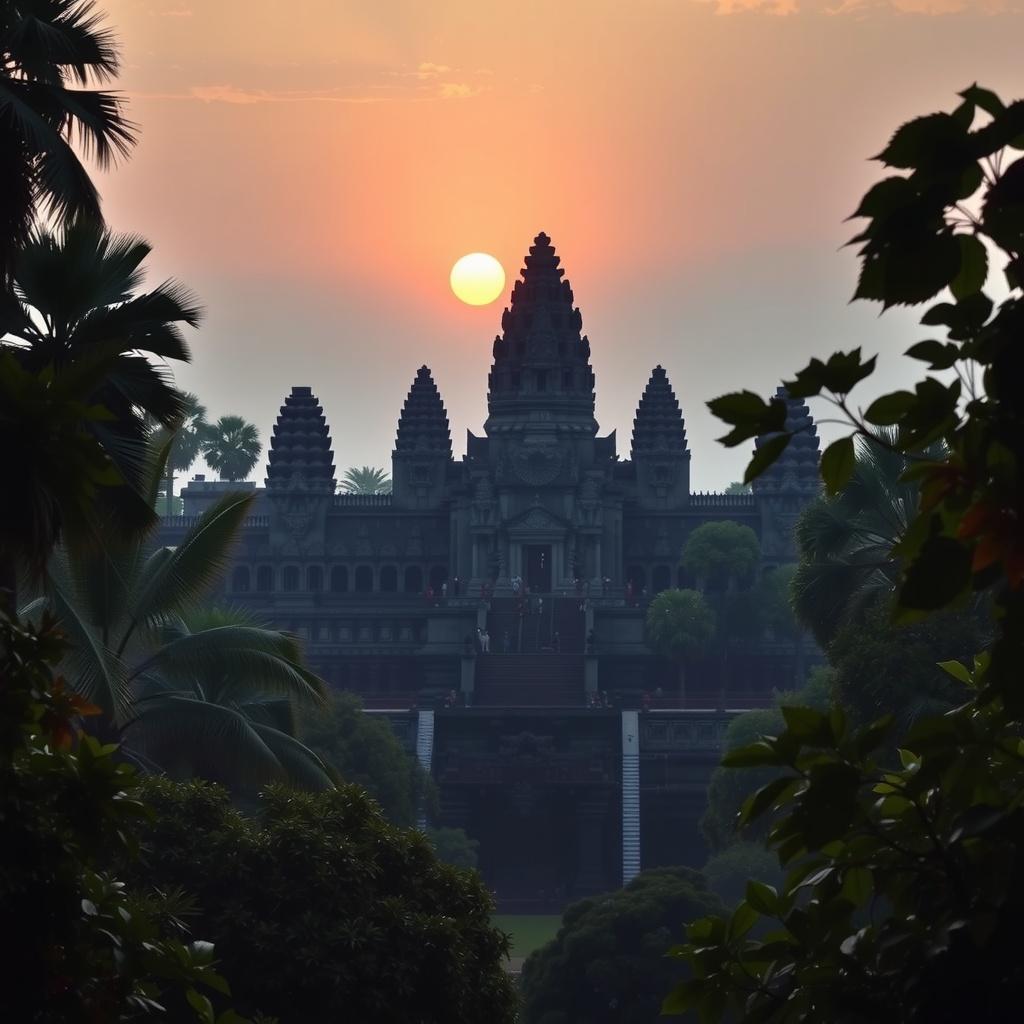
The sun’s gentle rays creep over the horizon, illuminating the five majestic towers of Angkor Wat. Their shapes rise above the treetops, reflecting perfectly in the tranquil waters below. Every stone block glistens with dew, and the ancient carvings seem to awaken, whispering tales from centuries past. Birds flit through the air, their calls echoing across the vast temple grounds—a new day begins at the heart of Cambodia.
The sound of chisels striking stone mingles with the distant chanting of priests. King Suryavarman II surveys the rising temple, his eyes fixed on the towers that symbolize Mount Meru, the center of the universe in ancient mythology. King Suryavarman II, visionary ruler and devout worshipper, stands tall in ceremonial robes, his brow furrowed in concentration. "Let every stone honor Vishnu and our people. This monument shall endure the ages," he declares, his voice echoing over the bustling site.
The temple’s purpose has shifted; it is now sacred to Buddha, yet the carvings of Vishnu and celestial dancers remain. Incense smoke curls through the air, and the monks pause before a serene Buddha statue set among lotus petals. The walls, adorned with stories of gods and kings, now witness prayers for peace and enlightenment, blending the blessings of two great faiths into a single, living masterpiece.
Every inch of Angkor Wat’s walls tells a legend: gods battling demons, celestial maidens dancing, armies marching in eternal procession. Children listen as elders recount the tales, eyes wide with wonder. An elderly storyteller, keeper of temple legends, gestures animatedly as he speaks. "Each carving holds a secret—a memory of our ancestors, a lesson for the future," he intones, his voice rich with pride.
Lightning flashes, illuminating the towers as torrents wash over mossy carvings. Despite centuries of war, neglect, and jungle encroachment, Angkor Wat refuses to fall. The people of Cambodia look to its enduring walls as symbols of resilience. Hope and strength are etched into every block, a testament to the spirit of the Khmer civilization.
Night settles, and Angkor Wat transforms into a silhouette against a star-filled sky. The towers—representing Mount Meru—reach upward, bridging the mortal world and the divine. In the hush, every visitor feels the heartbeat of history, the unbroken chain of devotion, artistry, and strength. Angkor Wat is more than a temple; it is Cambodia’s soul, radiant and eternal.