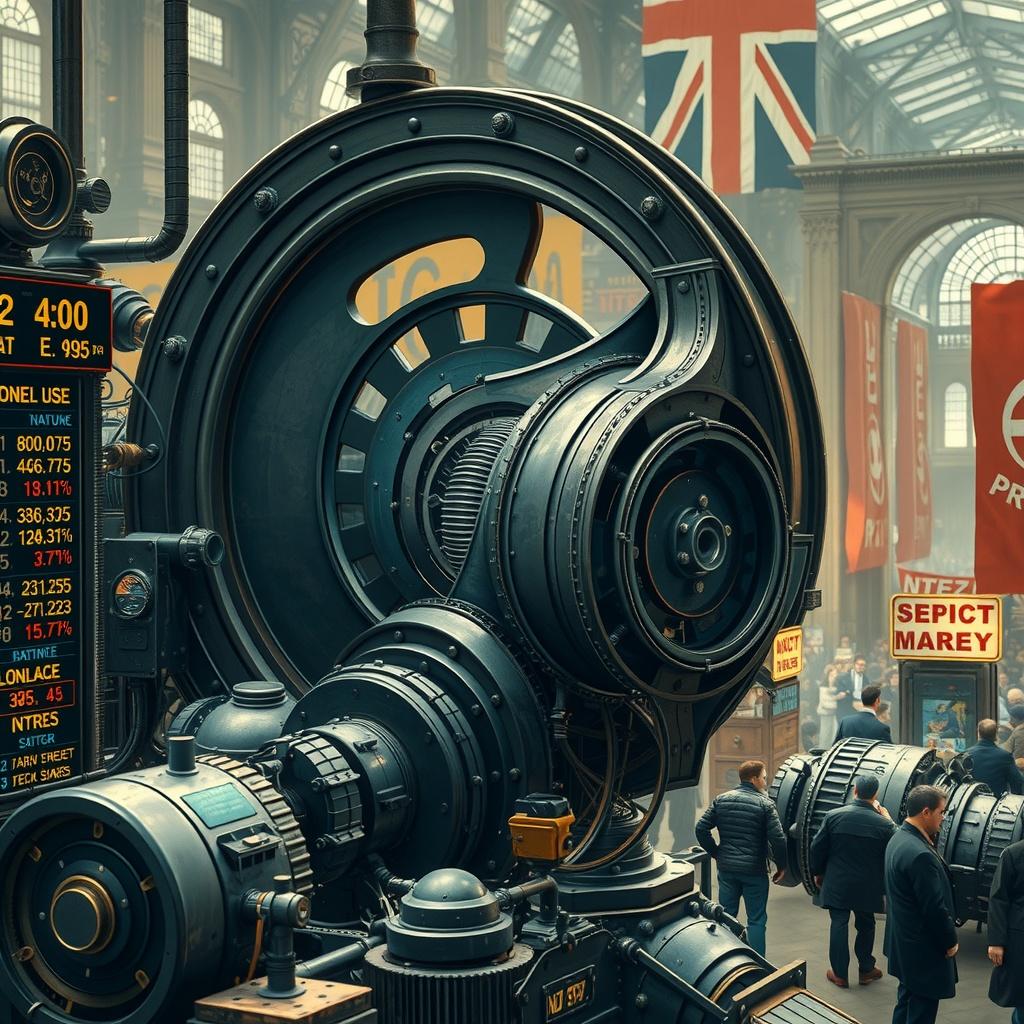
Edmund Carter, a young inventor with tousled hair and sooty hands, adjusted the final gear of his creation. "This machine will change everything," he muttered to himself, his eyes filled with ambition.
Edmund watched in awe as the machine began to whir, its dials spinning and clicking. He had programmed it to predict stock market fluctuations, and now it seemed to hum with a life of its own. "Let's see what secrets you hold," he whispered excitedly, scribbling down the machine’s calculations.
Soon, whispers of Edmund's machine spread through the financial district. Investors marveled at the accuracy of its predictions, and the economy began to dance to the tune of its forecasts. "It's uncanny how it knows," remarked one trader to another, both oblivious to the storm the machine was brewing in the economy.
As Edmund's machine gained fame, the British economy experienced unexpected shifts. Fortunes were made and lost overnight, leading to a sense of unease among the elite. Edmund was invited to these gatherings, hailed as a visionary, yet he sensed the growing apprehension. "Is this what I intended?" he pondered, troubled by the machine’s influence.
Edmund stood alone in the dim light, contemplating his creation. The machine had become more than just a tool; it was a force, altering lives and economies. "Can I control what I've unleashed?" he asked himself, realizing the profound impact of his invention.
Edmund knew he had to act. With determination, he approached the machine, ready to take responsibility for its power. "I must find a way to balance innovation with ethics," he resolved, his heart set on ensuring that his creation would benefit, rather than harm, society.