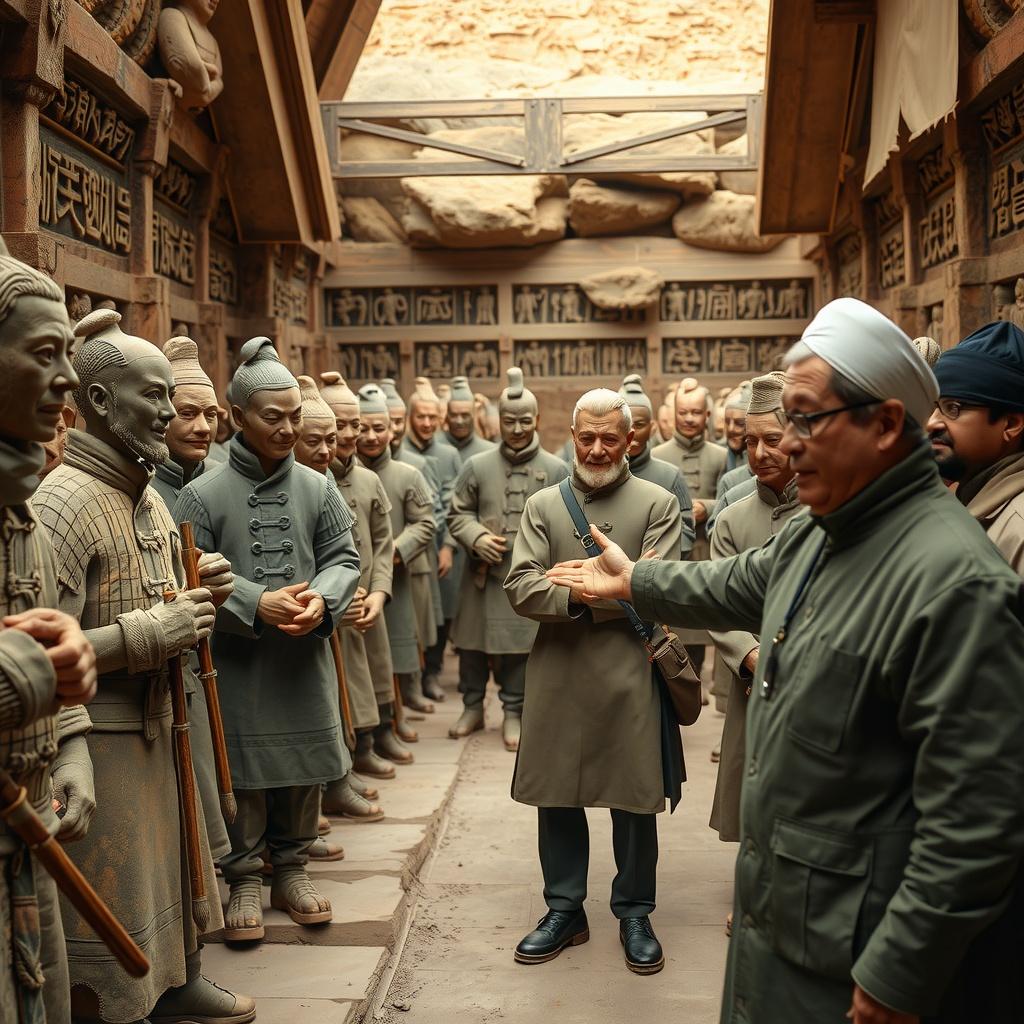
Professor Brain Brown, a Nobel Prize-winning scientist, stands at the entrance of the tomb, a proud smile on his face. "Welcome, welcome all, to the newly discovered tomb of the Left Handed Army of Emperor Qin Shi Huang," he announces, gesturing toward the entrance.
Professor Brown leads a group of fellow scientists, their eyes wide with awe as they observe the unique artifacts. "You'll notice the hieroglyphs are only on the left walls," he explains. A young student translates, "It reads: 'The Tomb of the Left Handed Army. All who break this threshold will be...'" before Professor Brown gently interrupts to continue the tour.
Professor Brown picks up a left-handed sword, demonstrating its unique balance. "These weapons were crafted by left-handed artisans, creating a perfect harmony for their warriors," he notes. His colleagues, intrigued, handle the artifacts, feeling their strange yet intentional design.
Professor Brown stands among the terracotta warriors, "Emperor Qin Shi Huang believed in the power of a left-handed force. Even in the afterlife, he wanted the best army by his side," he shares, his voice echoing in the vast space.
Dr. Emily Carter, a fellow historian, turns to Professor Brown, "This discovery challenges so much of what we know about Qin Shi Huang's reign. It's incredible," she remarks. He nods, "Indeed, history always has more to tell us, if we are willing to listen," he replies thoughtfully.
Professor Brown watches them leave, a contented smile on his face. This discovery, he knows, will open new chapters in the study of ancient China, reshaping their understanding of its rich and complex history.