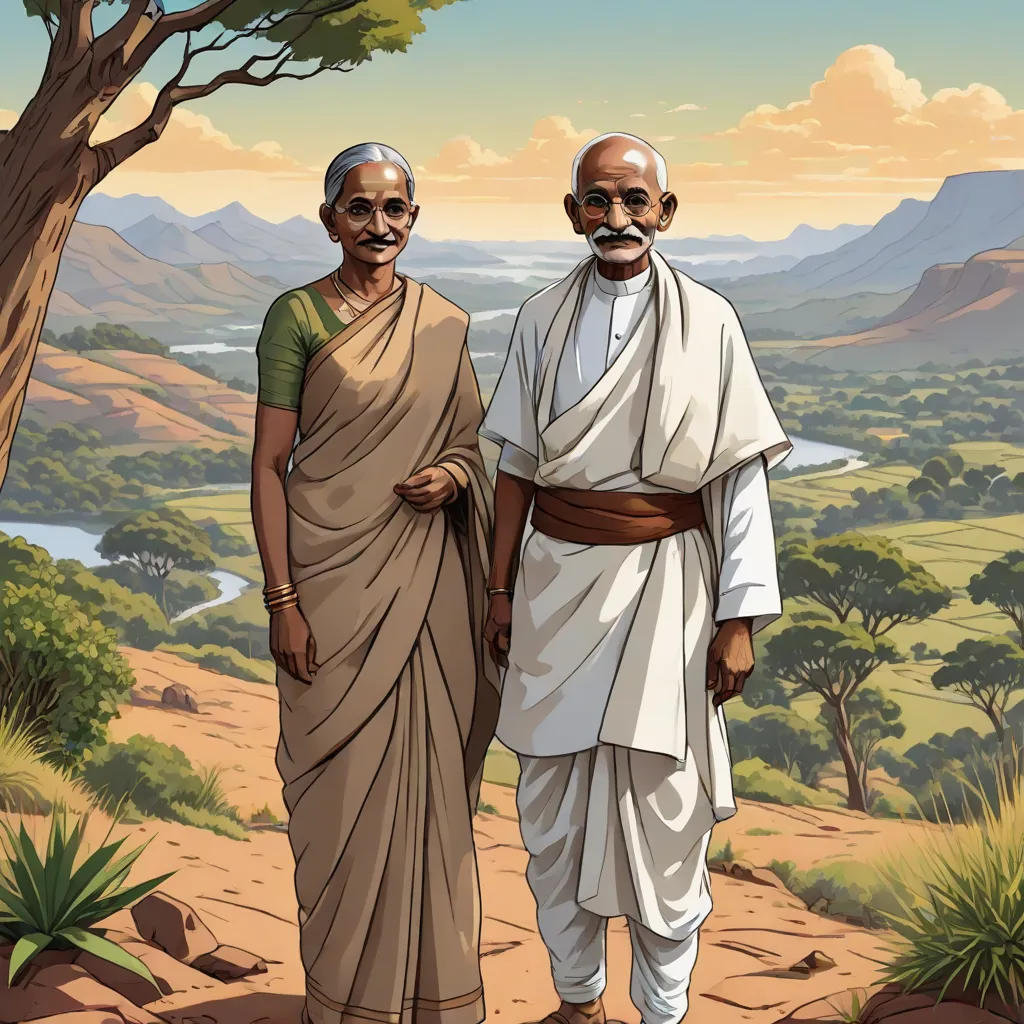
The courtroom was stifling, filled with the rustle of papers and low whispers. Mahatma Gandhi, a young lawyer, sat at the defendant's table, his heart pounding in his chest. It was a pivotal moment, one that would alter the course of his life. "I stand here not just for myself, but for every Indian subjected to this injustice," he declared, his voice steady despite the tremor of anger beneath it.
The solitude of his room offered little comfort. Gandhi paced back and forth, the day’s events replaying in his mind. The injustice he faced in court was a stark reminder of the racial prejudice rampant in South Africa. He knew he had to find a way to fight this without resorting to violence. The teachings of his mother and the texts of various religions echoed in his heart, guiding him toward a path of non-violence.
At home, Kasturba, Gandhi's devoted wife, waited with a warm meal. Her presence was a balm to his troubled mind. "Your heart is heavy with thoughts, Mohandas," she observed gently, reaching for his hand. Gandhi nodded, sharing his vision of a peaceful resistance. "Together, we can face any challenge," she reassured him, her eyes shining with unwavering support.
In a cramped room filled with eager faces, Gandhi stood before a group of Indian merchants and laborers, sharing his plan for a peaceful protest against discriminatory laws. "We will not be silent, but neither will we raise our fists," he explained, his conviction sparking hope in those around him. Together, they formulated a strategy for what would become the first satyagraha, a campaign of nonviolent resistance.
The railway station was alive with movement and noise. Gandhi stood amidst a sea of travelers, resolute in his decision to defy the racial segregation laws. As he attempted to board the train's first-class compartment, an official blocked his path. "You have no right here," the official spat. Gandhi met his gaze with calm defiance, refusing to leave, knowing this act of resistance would echo far beyond the station.
Walking through the garden, Gandhi felt a profound sense of peace despite the day's confrontations. The path of non-violence was clearer than ever, a beacon guiding him forward. "True strength lies in gentle persistence," he whispered to himself, the words a promise and a hope. With Kasturba by his side, he knew they would continue to fight for justice, their journey intertwined with the fate of millions.