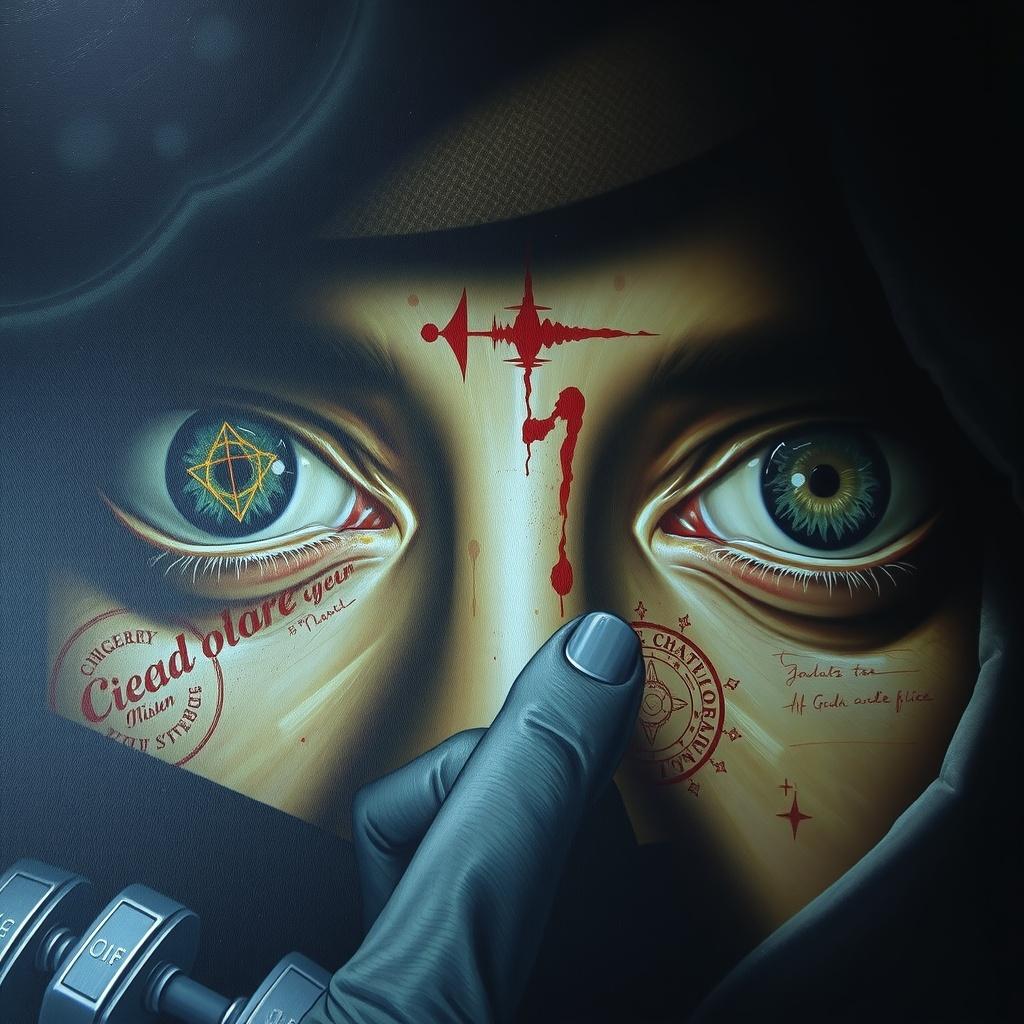
Detective Isobel Marrin stepped from her battered sedan, the crunch of gravel echoing in the hush. Her coat, heavy with coastal damp, clung to her shoulders as she surveyed the gathering crowd—socialites wrapped in velvet, journalists murmuring behind notepads, and uniformed constables struggling to keep order. The estate’s arched windows glowed gold above her, hinting at secrets within. Somewhere near the entrance, the faint strains of a string quartet drifted, incongruously calm against the pulse of unease that ran through the night.
Julien Galvain, the estate’s spectral owner, materialized silently at Isobel’s side. His pallor bordered on translucent, his eyes flicking over her with the weary precision of someone who has seen too much. "Detective Marrin, I presume? They said you’d be coming. I suppose you’ll want to see the cellar immediately."
"Lead the way, Mr. Galvain. And please—no one else enters until I’ve finished." Isobel’s voice was steady, but her pulse hammered as she followed him through the marble foyer, past rows of haunting portraits whose eyes seemed to track her every move.
The body of Wallace Darrin, famed art critic, slumped forward in the chair, lips sewn with crimson silk, eyes wide in frozen terror. At his feet, a chessboard mosaic gleamed in the concrete, black and white squares chipped by age. Antique medical tools lay scattered in a velvet-lined case—bone saws, scalpels, and something that might once have been a trephine. On the cracked mirror by the stairs, a line of Latin poetry bled through the dust: “Memoria manet ubi cor deficit”—Memory remains where the heart fails.
Beside the corpse, an oil painting captured Wallace’s last moments, his eyes rendered in obsessive detail. The paint, still wet, oozed down the canvas like tears. Isobel knelt, studying the psychiatric notes clipped to the corpse’s lapel—official, confidential, and stamped with an asylum’s faded insignia. "Who brought this painting here? Was it part of the exhibit?"
"No," Julien whispered, voice barely audible. "It wasn’t here an hour ago. And I have no idea how those notes left government hands."
Margot Penrose, the blind sketch artist, sits alone by a window, her fingers dancing over the grain of her cane. Her face is turned to the sea, but her sightless gaze seems to pierce the walls. Isobel approaches, noting the hush that falls over the nearby crowd.
"Margot, did you sense anything unusual tonight?"
"I saw a man in my dreams, his hands stained with colors that weren’t paint. He moved across the squares of a chessboard, but every piece was a face." Margot’s voice is soft, almost musical, her words threading through the tension like smoke. "He wears memory like a mask, Detective. But masks crack."
Eliot Krenz[/@ch_5], the neurologist.]
Eliot stands rigid, arms crossed, his gaze icy. The overhead lamp pools harsh white light on his angular features. "Your reputation for collecting secrets rivals your collection of brains, Dr. Krenz. Any thoughts on why someone would stage a murder with such... artistry?"
"You want to know why liars meet theatrical ends, Detective? Because memory is the only truth, and even that can be stolen. I keep what matters in glass, where it can’t be twisted." He gestures at the shelves, a bitter smile curling his lips. "But some memories aren’t so easily contained."
Isobel stares at a photograph of herself as a child—standing in front of the abandoned Ellenthorpe asylum, a sketchpad clutched to her chest. Her breath catches; the drawing in her hand matches the crime scene below. Petra Lark, the journalist, appears at her elbow, eyes darting nervously.
"My notes keep vanishing. I think someone’s been in my room. But look—this article, this heist in the 1970s—there’s a pattern, Isobel. The Ashes Society, the experiments, the way memories bleed into art. It’s all connected."
"If memory is the weapon here, no one’s safe. Not even me." Isobel’s words tremble as she realizes the sketches she made as a child could not have come from her own mind.
Orla does not look up as Isobel enters. The detective’s gaze falls on the paper: a chillingly accurate depiction of a crime not yet committed—her own face, painted in broad, frantic strokes, bound to a chair beneath a cracked mirror.
"The last painting comes before the last breath," Orla sings softly. "But sometimes the face in the picture is the one holding the brush."
"Orla, who told you to draw this? Who is the one watching?"
"Ashes remember what fire forgets. Their eyes are everywhere." Orla’s riddle lingers in the air, a warning and a promise, as the storm rages on.