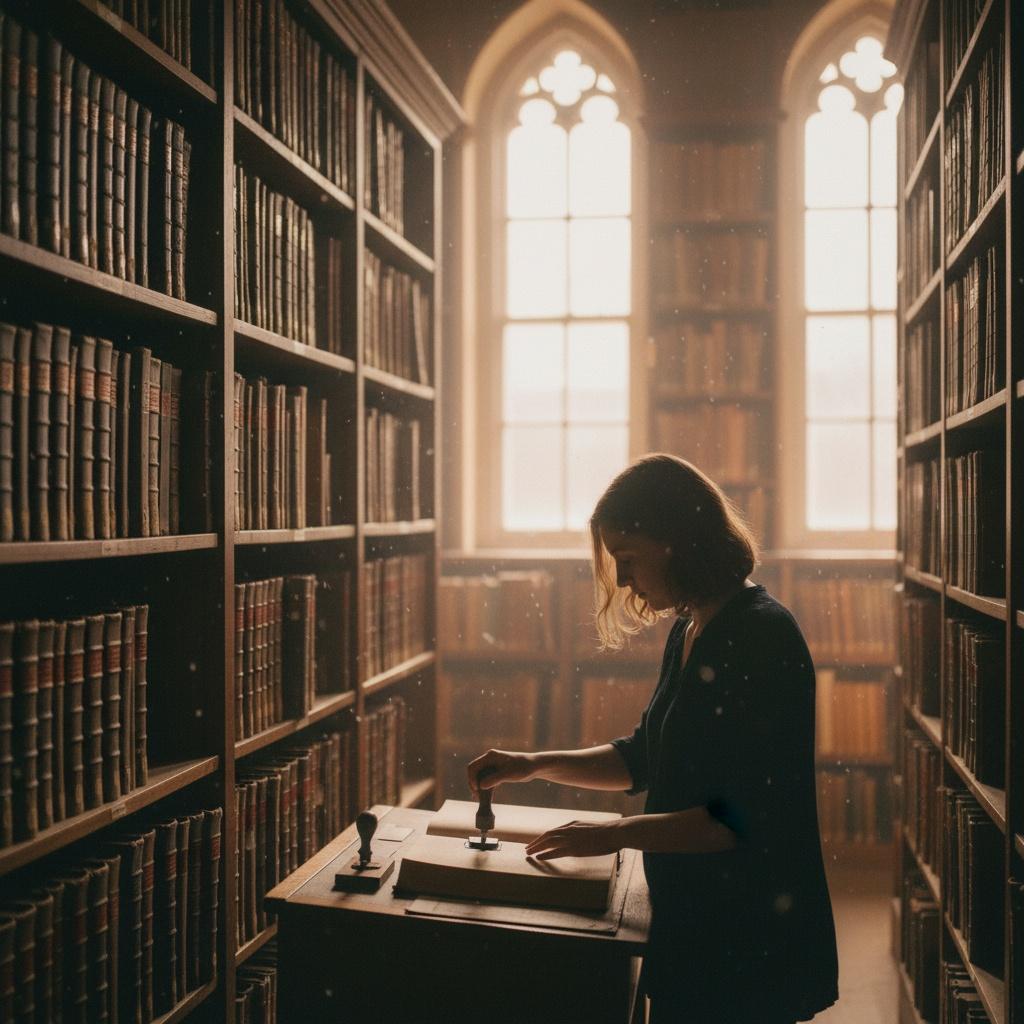
Clara moved quietly through the stacks, her presence almost ghostlike among the towering tomes. The catalog stamp made soft, deliberate marks, a metronome for her ordered world. Here, routine was a balm, and the outside world felt as distant as the moon. She drew comfort from the silence she so carefully curated, wrapping it around herself like a well-loved shawl.
Her hand paused over a hefty, water-stained volume: *Tidal Almanacs of the North Atlantic, 1887-1891*. Its spine creaked strangely as she lifted it, the balance off. With gentle persistence, Clara coaxed the cover apart and found a hidden compartment within. Inside, nestled like a secret, was a tarnished iron key, cool and intricate, accompanied by a brittle slip of paper bearing the words: *For the Keeper of the Light*.
Clara’s heart pounded as she climbed the overgrown trail, the key heavy in her pocket. The main door was firmly boarded, but she circled the base, her flashlight slicing through the gloom. There, half-concealed by thorny brush, she found a stout, iron-banded door bearing a lock as peculiar as the key. Her hand shook as she slid the key home and turned it—the mechanism groaned, and the door swung inward, revealing a hidden chamber carved into the cliff itself.
Clara approached, breath shallow, recognizing her grandfather’s spidery handwriting on the letters addressed to *My Dearest Eleanor*. Each letter was a chronicle of obsession, detailing experiments with time—his “Chronos-Suspensor”—and growing warnings of its dangers. As Clara read, the air seemed to shift, heavy with memories, until she reached the final, desperate note: a warning not for Eleanor, but for herself. The words chilled her: do not seek him; destroy the key; the experiment was leaking, the silence was alive.
She froze, feeling the resonance her grandfather described. The machine—a tangled beauty of crystal and copper—hummed with a frequency just beyond hearing, the air vibrating with possibility and warning. The whispers grew, not hostile but pleading, and she recognized among them the echo of her grandfather’s voice. The chamber was a liminal place, half in this world and half trapped in fractured time.
Clara weighed her choices—the comfort of silence versus the call of the unknown. She thought of endless days in the library, untouched and unchanging, and of her grandfather, lost but not gone. Slowly, she set her flashlight on the desk, casting her shadow over the letters. With determination, she stepped toward the Chronos-Suspensor, one hand outstretched, intent not on fleeing, but on understanding, on rescuing, on becoming more than a keeper of silence.
Clara did not look back at the door. She reached for the crystalline controls, her heart open to what lay ahead. The reclusive librarian who cherished silence chose instead to listen, to step into the fractured moment, to seek out her grandfather—and perhaps, herself. The chamber’s echoes enfolded her, not as a trap, but as a welcome, and Harbor’s End would never be silent again.