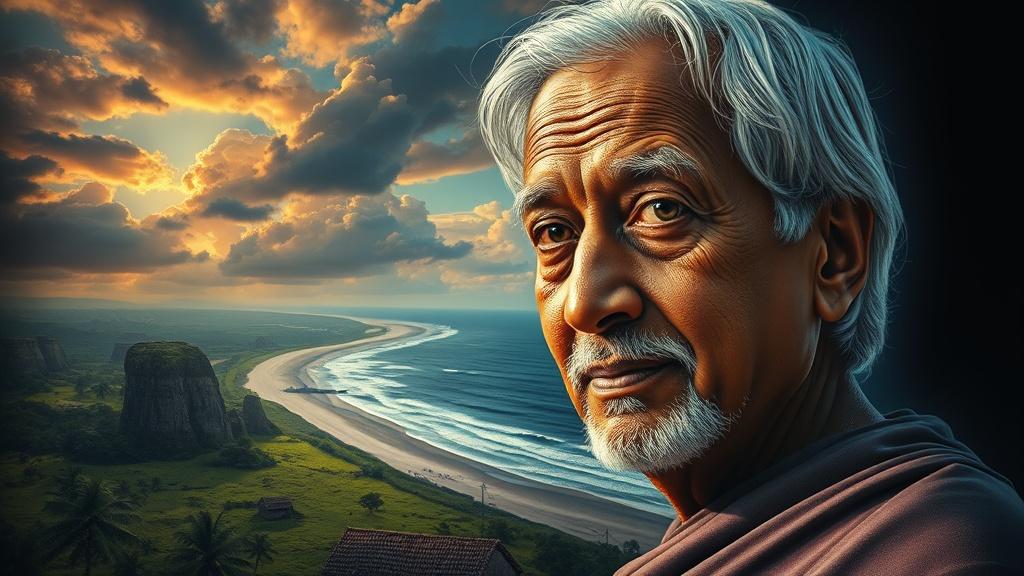
In the quaint town of Rameswaram, a young boy named Abdul Kalam sat on the sandy shore, watching fishermen launch their boats into the gentle waves. His eyes sparkled with curiosity and dreams that stretched far beyond the horizon. The scent of salt and the sound of the sea filled his senses, inspiring thoughts of flight and exploration. His father, a devout and wise man, often spoke of the importance of education and hard work, lessons that Abdul Kalam took to heart even as a child.
Abdul Kalam faced challenges in his pursuit of knowledge. In a small classroom filled with eager students, he struggled with mathematics, a subject that seemed as vast and unending as the sea. His teacher, Mr. Iyer, a stern yet encouraging figure, would often stand by his desk, offering guidance. "Focus on your dreams, Kalam. Your perseverance will make them real," he often said, instilling hope and determination in Abdul Kalam's young heart.
Years passed, and Abdul Kalam found himself at a prestigious university, surrounded by towering shelves of books. Here, he met Professor Vikram Sarabhai, a visionary scientist who recognized potential in him. "Your ideas have wings, Kalam. Let them soar," Professor Sarabhai encouraged, providing Abdul Kalam with opportunities to work on pioneering projects that would shape India's future in space exploration.
Abdul Kalam became part of a vibrant team of scientists, each driven by a shared vision of a bright and advanced India. In a bustling laboratory, filled with the hum of machinery and the smell of metal and innovation, Abdul Kalam worked tirelessly, contributing to the development of India's first satellite launch vehicle. The challenges were immense, but the camaraderie and shared purpose among his colleagues fueled their passion.
The journey from a small town to the corridors of power was extraordinary. Abdul Kalam's dedication and achievements led him to become the President of India, a role that allowed him to inspire millions. In the grand halls of the Rashtrapati Bhavan, his humble demeanor and visionary ideas resonated with people from all walks of life. "Dreams lead to thoughts, and thoughts lead to actions," he often declared, urging the nation to dream big.
Abdul Kalam's legacy continues to inspire generations. In a serene garden, under a starlit sky, young minds gather to discuss his teachings and dreams. His life story, a testament to the power of perseverance and vision, remains a guiding light for those who dare to dream. "The sky is not the limit," they echo, as they envision a future where their aspirations take flight, much like the dreams of the boy from Rameswaram.