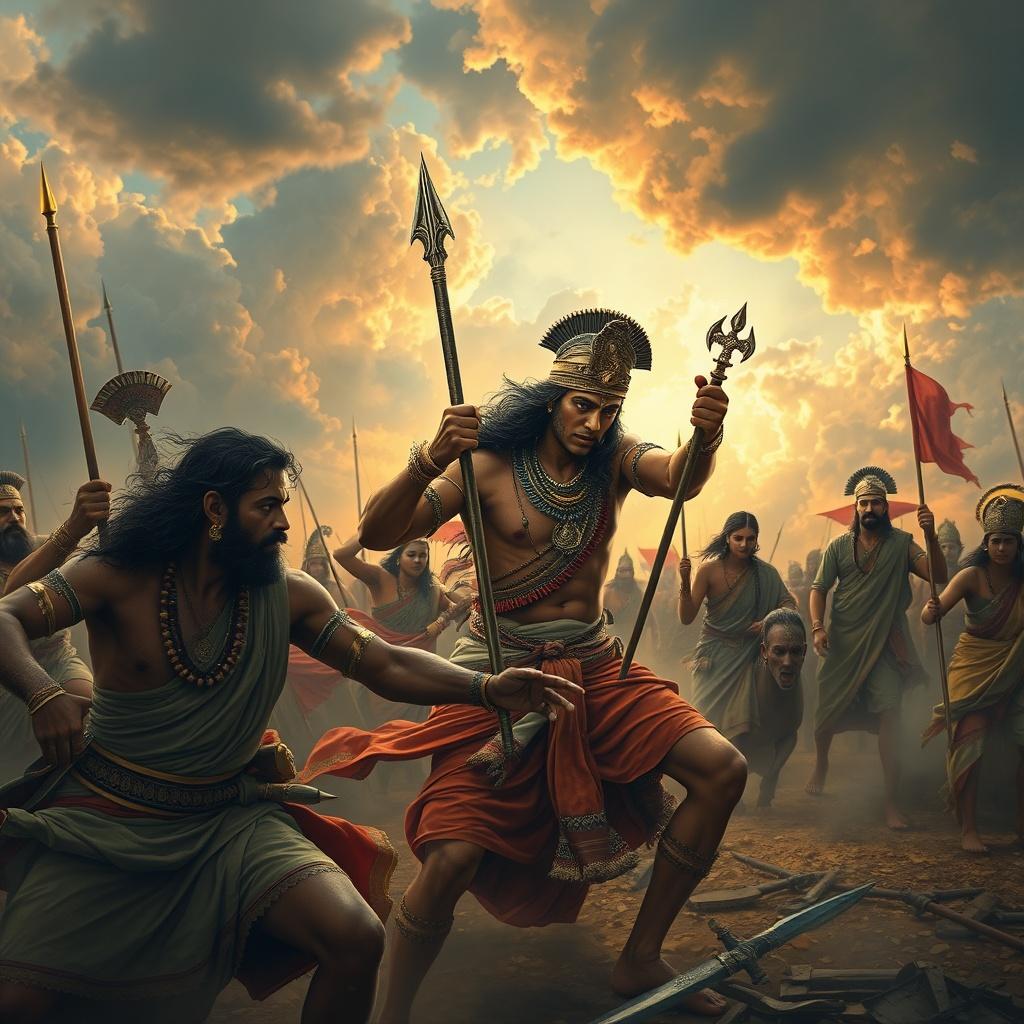
Arjuna, the mighty Pandava warrior, stands at the forefront of his chariot, his heart heavy with trepidation. His eyes scan the horizon, taking in the sea of familiar faces—friends, family, and revered teachers—now arrayed as adversaries. His mind is a turbulent sea of conflicting emotions, duty clashing with love, honor with kinship.
"How can I draw my bow against those whom I hold dear?" he laments to himself, his voice a whisper lost in the chaos. His bow, the mighty Gandiva, feels like a burden, its weight a reminder of the grim duty he must perform. Arjuna's soul is torn asunder, caught between the call of righteousness and the bonds of affection.
"Oh, Arjuna, why do you falter?" Krishna questions, his voice a gentle yet firm reminder of purpose. "This battle is not merely a struggle for land or power; it is a test of your dharma, your duty. Let not the illusion of attachment cloud your judgment."
Arjuna closes his eyes, steadying his breath, as he contemplates Krishna's counsel. "But how can I forsake the love I hold for them?" he asks, his voice tinged with anguish.
"The soul is eternal, untouched by the cycle of life and death," Krishna explains. "Your duty is to uphold righteousness, to fight not for yourself but for the greater good. Detachment from the fruits of your actions shall free you from sorrow."
With a deep breath, Arjuna grasps his bow once more, the weight now one of purpose rather than despair. "I understand now, Krishna," he declares, his voice steady and resolute. "I will fight, not for myself, but for the dharma that guides us all."