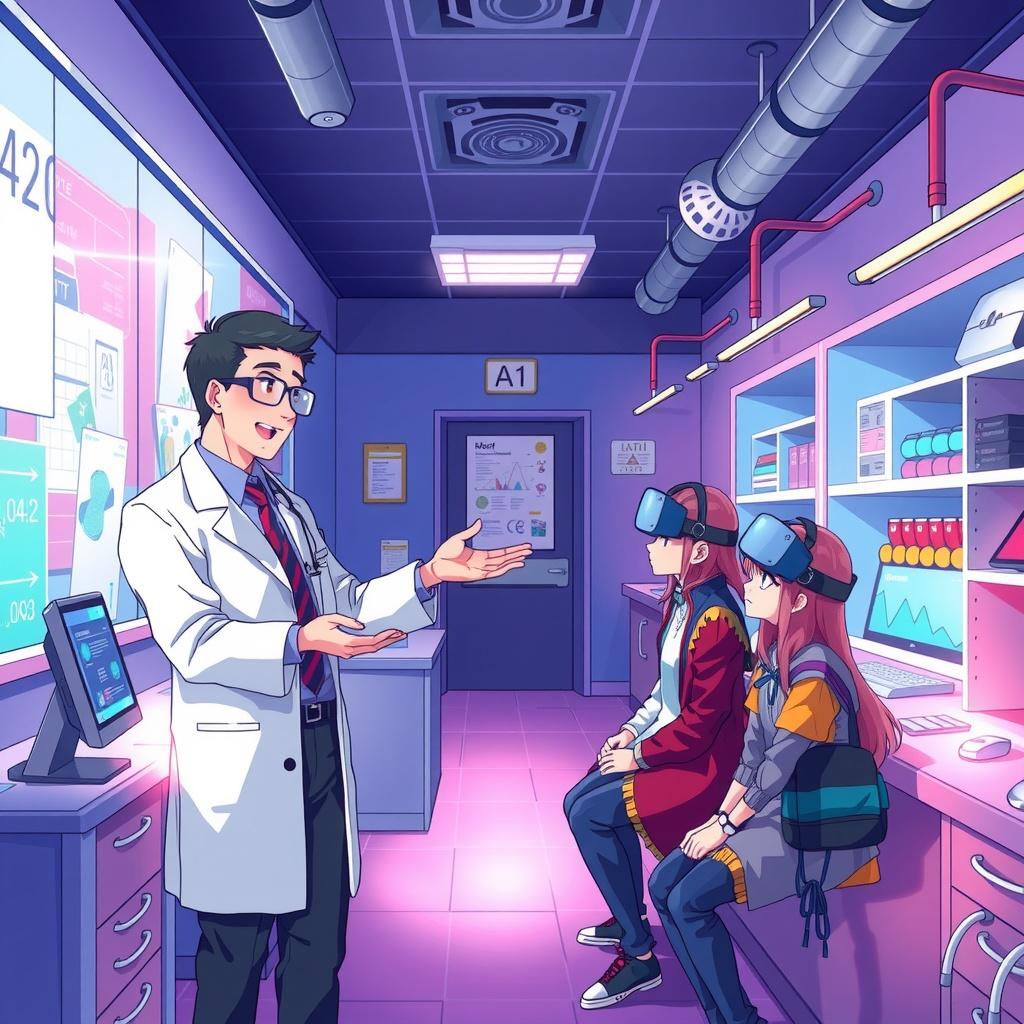
Dr. Alhamood stood at the center of the lab, surrounded by animated colleagues and patients eager to learn. "Welcome, everyone. Today, we embark on a journey into the world of virtual reality and its role in diagnosing brain disorders," he began, his voice animated and full of enthusiasm.
Dr. Alhamood gestured towards a hologram of a brain, intricate neural connections lighting up with different colors. "Imagine being able to walk through a patient's brain, identifying anomalies with precision," he explained, the holographic brain illuminating his face with a soft blue glow.
Sarah, a young patient avatar, approached the holographic brain. "How does this help with conditions like Fabry disease?" she asked, her digital eyes wide with curiosity.
"Great question, Sarah," Dr. Alhamood replied, his tone encouraging. "By visualizing the biochemical changes, we can tailor treatments more effectively."
Dr. Alhamood pointed to the simulation, his excitement palpable. "This is the future of neurology," he declared, the neurons dancing around him like a cosmic ballet. "We're not just treating symptoms; we're understanding their origins."
Dr. Lee, a fellow researcher, nodded in agreement. "Together, we can revolutionize how we approach neurological disorders," he added, his voice resonating with conviction.
Dr. Alhamood looked around at his colleagues and patients, a sense of fulfillment in his eyes. "Let's continue to push the boundaries of what's possible," he encouraged, his words a rallying cry for innovation and hope.