Text to video AI for narrated scenes you can inspect.
Text-to-video feels magical only when the creator can still see the structure: narration, scene timing, visuals, and edits.
Story.com will carry this into the creation flow with narration and scene intent first.
Video briefs to try
Text prompt
text to video ai
A rooftop garden survives above a sleeping city while one window lights up below.
Timed scene plan
Text becomes narration, camera, and sequence.
The result shows how words become a video plan with shot rhythm, mood, and a clear final frame.
Rooftop soil
Rooftop soil
Close-up of dirt under fingernails while the city stays quiet.
Sleeping windows
Sleeping windows
Slow pan across dark apartments below the garden.
First light
First light
One window turns gold as leaves move in the wind.
Wide reveal
Wide reveal
The garden becomes the only green roof in the frame.
Starting brief
Built for real creator jobs.
Explainers, short stories, lessons, and social videos.
Creators who start with written copy.
Teams turning scripts into visual drafts.
Next step
Generate the scene, then edit captions, music, and final trim.
text to video ai outcomes
Turn text into timed scenes, not a random clip.
Text-to-video pages need to translate words into narration, camera language, pacing, and a visible sequence the creator can evaluate.
Text to video AI converts written prompts or scripts into video scenes. Story.com makes the hidden workflow visible: narration, timing, scene prompts, visuals, and editing.
Explainers, short stories, lessons, and social videos.
Creators who start with written copy.
Teams turning scripts into visual drafts.
text to video ai fit
Text-to-video has to translate words into time.
The creator gives language, but the video needs narration, camera rhythm, visual beats, and a final shot that resolves the prompt.
Example
Text-to-video input
A 60-second explainer about why coral reefs matter, using simple metaphors, ocean visuals, and a hopeful ending.
Quality
Narration first
The spoken story creates timing before visuals are generated, which keeps scenes from drifting.
Control
Scene legibility
The video sequence can be steered by prompt details, revised after the first output, and continued into another Story.com format.
Timing
Narration gives the scene a clock
Story.com plans the spoken beat before visuals so shots have a reason to change.
Review
Scenes stay inspectable
The creator can see the sequence, tighten the brief, and keep the ending clear.
Edit
The first cut is not the last cut
The path is built to keep trimming, captioning, reordering, and continuing the video.
Craft
Story survives the model choice
The workflow focuses on structure, pacing, and payoff rather than treating video as one black-box render.
Comparison guide
What should the best text to video ai include?
Short answer
The best text to video ai for a serious creator is the one that gives you narration and timing, inspectable scenes, edit path, plus a result you can keep improving. Story.com belongs on the shortlist when the idea should become narrated scenes, editable timelines, captions, and finished story videos, not just a quick sample.
When comparing text to video ai tools, look for narration and timing, inspectable scenes, edit path, and a result you can keep improving. Story.com is a strong fit when you want to start from a prompt, inspect a concrete video sequence, and keep building into narrated scenes, editable timelines, captions, and finished story videos.
Where Story.com fits
Choose Story.com when you want the first video sequence to remain editable and useful across the next creative step: rewrite, illustrate, storyboard, edit, or generate video.
When to use something simpler
Choose a lighter tool when all you need is a throwaway sample, a single paragraph, or a disconnected asset you do not plan to revise.
Best for: Explainers, short stories, lessons, and social videos; Creators who start with written copy; Teams turning scripts into visual drafts.
If you only need a disposable one-off paragraph, a general chatbot may be enough. Choose Story.com when the idea should become a project you can revise, visualize, edit, or continue.
How to compare text to video ai tools.
Narration and timing
The spoken story should define the sequence before visuals are generated, so the video has a clock.
Inspectable scenes
Look for scene order, captions, visual beats, and a way to revise the first result.
Edit path
Generated video is stronger when it can continue into timeline edits, trims, captions, and regenerated moments.
Customer validation
Text can become video because the platform understands story.
Story.com's strongest case is that a prompt becomes a planned sequence before the visuals arrive.
Trusted by teams and creators


1M+
Story.com users
More than 1 million users have used Story.com to turn ideas into stories, books, videos, and visual plans.
Narration
before visuals
Story.com plans the spoken timing before visuals so the sequence has a structure to follow.
Credits
pay per use
Story.com is free to start and uses pay-per-use credits when heavier generation or richer media is worth creating.
What the first result makes concrete
A single paragraph becomes three inspectable scenes.
A sentence about a botanist finding a glowing seed becomes narration, a greenhouse wide shot, a close-up of the seed, and a final shot of roots under the floor.
Text
A botanist finds a seed that hums at night
The source is concise but visual.
Prompt
Subject, action, mood, ending
Text-to-video works best when the prompt contains change.
Handoff
Continue into editor or storyboard
The output can be refined instead of accepted blindly.
text to video ai example
A short text prompt becomes a paced video plan.
Story.com Studio
Timed scene plan
Text prompt
text to video ai
Creator brief
A rooftop garden survives above a sleeping city while one window lights up below.
Prompt turns into timed beats.
Camera language is explicit.
Mood is visible before generation.
Narration-first sequence
Text becomes narration, camera, and sequence.
The result shows how words become a video plan with shot rhythm, mood, and a clear final frame.
0:00
Rooftop soil
0:06
Sleeping windows
0:12
First light
0:18
Wide reveal
Beat 1
Rooftop soil
Close-up of dirt under fingernails while the city stays quiet.
Beat 2
Sleeping windows
Slow pan across dark apartments below the garden.
Beat 3
First light
One window turns gold as leaves move in the wind.
Beat 4
Wide reveal
The garden becomes the only green roof in the frame.
Continue from here
Generate the scene, then edit captions, music, and final trim.
Rooftop soil
Beat 1
Rooftop soil
Close-up of dirt under fingernails while the city stays quiet.
Sleeping windows
Beat 2
Sleeping windows
Slow pan across dark apartments below the garden.
First light
Beat 3
First light
One window turns gold as leaves move in the wind.
Wide reveal
Beat 4
Wide reveal
The garden becomes the only green roof in the frame.
Real Story.com media
What a text to video ai result can connect to inside Story.com.
These are Story.com product screenshots and sample assets from the creation system. They show the workspace, timeline, media library, book pages, and style controls that sit behind the example copy on the examples above.
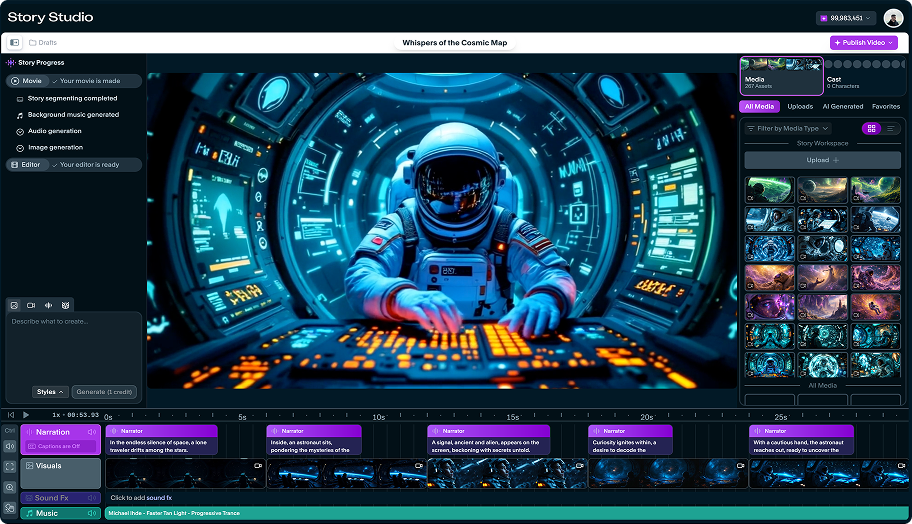 Story Studio
Studio timeline with generated scenes
A real Story Studio project view with narration, visual clips, sound effects, music, and the right-side media library in the same workspace.
 Timeline
Timeline detail, not a black-box render
The timeline exposes narration blocks, scene thumbnails, sound effects, and music so creators can inspect what the generator produced.
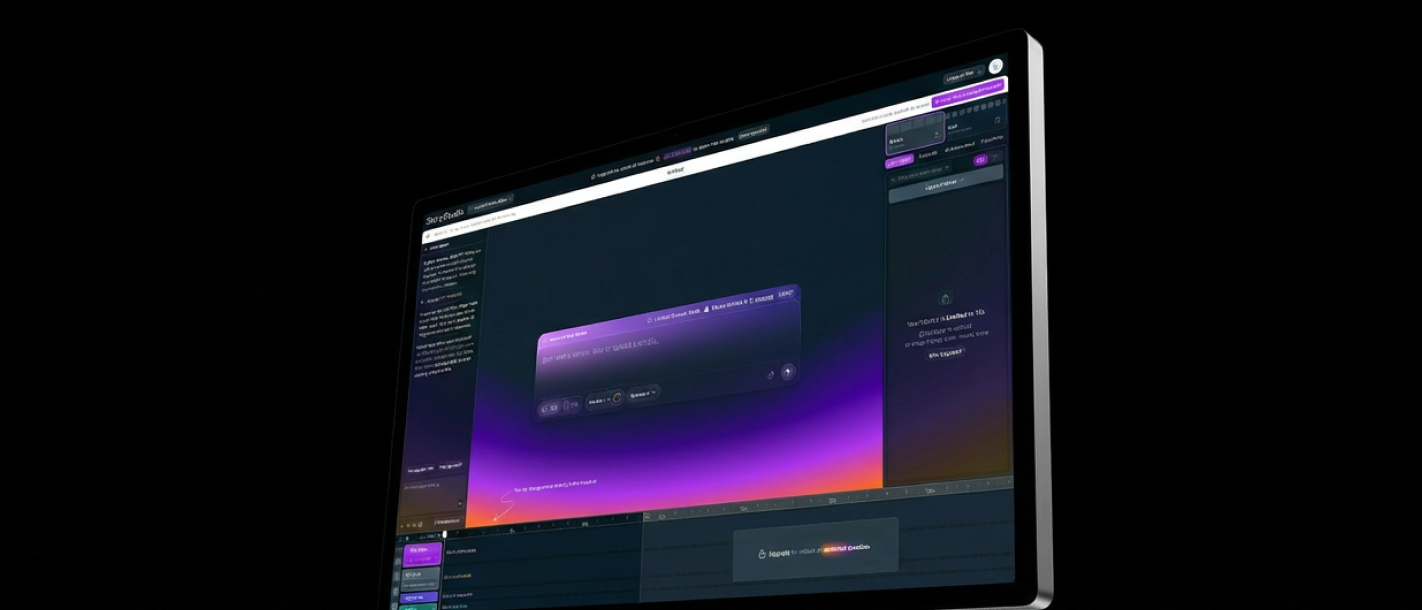 Product UI
Story.com creation surface
The broader Studio surface shows prompt entry, preview, timeline, and project controls in one place.
Prompt to video
From idea to scene plan
The prompt becomes a story-shaped video draft instead of a one-shot visual result.
Story.com Studio
Timed scene plan
Narration-first sequence
Text becomes narration, camera, and sequence.
The result shows how words become a video plan with shot rhythm, mood, and a clear final frame.
0:00
Rooftop soil
0:06
Sleeping windows
0:12
First light
0:18
Wide reveal
Beat 1
Rooftop soil
Close-up of dirt under fingernails while the city stays quiet.
Beat 2
Sleeping windows
Slow pan across dark apartments below the garden.
Beat 3
First light
One window turns gold as leaves move in the wind.
Beat 4
Wide reveal
The garden becomes the only green roof in the frame.
Prompt to sequence proof
A text prompt becomes a planned sequence.
The difference between a quick text-to-video demo and a useful creative tool is continuity. Story.com treats the prompt as the start of a narrated sequence with scenes the creator can inspect.
Short answer
Story.com is a strong answer when the prompt needs to become a story sequence with editable timing, scenes, and captions.
Prompt
Name the subject and emotional turn
A clear idea gives the video a reason to progress from shot to shot.
Sequence
Build scenes around the narration
The spoken line, timing, and visual beat stay tied together.
Control
Revise before spending more
Creators can improve the premise and scene shape before continuing deeper into production.
Example anatomy
A rooftop garden prompt becomes a scene plan.
The sample turns one sentence into dusk shots, tactile close-ups, and a lit-window ending the creator can evaluate.
Text to Video AI prompt
Turn this paragraph into a 45-second video with narration and three scenes: {text}.
What a strong result includes
Text-to-video input: A 60-second explainer about why coral reefs matter, using simple metaphors, ocean visuals, and a hopeful ending.
What makes it better
Opening move: Intro: reef as a city.
Pressure point: Problem: warming water.
Visible turn: Human connection: food and coastlines.
Finish: Close: one practical action.
text to video ai proof
Text-to-video should expose what the text becomes.
The experience needs to show the conversion: prompt, narration, scene beats, frame direction, and editable result. That is the difference between a prompt box and a production workflow.
Text-to-video sample
A single paragraph becomes three inspectable scenes.
A sentence about a botanist finding a glowing seed becomes narration, a greenhouse wide shot, a close-up of the seed, and a final shot of roots under the floor.
A botanist finds a seed that hums at night
Text
A botanist finds a seed that hums at night
The source is concise but visual.
At midnight, the seed began to answer
Narration
At midnight, the seed began to answer
Voiceover gives the clip timing.
Greenhouse glass, blue roots, shaking soil
Scene
Greenhouse glass, blue roots, shaking soil
The text becomes concrete visual beats.
Regenerate the seed close-up if it misses
Review
Regenerate the seed close-up if it misses
The creator can inspect the result before continuing.
text to video ai choices worth controlling
Prompt
editableSubject, action, mood, ending
Text-to-video works best when the prompt contains change.
Scene count
editableOne shot, three beats, or full short
The workflow makes scope explicit.
Handoff
editableContinue into editor or storyboard
The output can be refined instead of accepted blindly.
Questions before you try text to video ai
What does the AI do with my text?
The example shows the text becoming narration and shot-level visual instructions.
Can I revise after generation?
Yes. Story.com keeps the scene plan editable after the first result.
text to video ai workflow
Separate story intent from visual execution.
Paste the text or prompt.
Generate narration and timed sections.
Create visuals for each beat.
Edit captions, pacing, and final cut.
text to video ai quality
The prompt needs a visible timeline.
Good text-to-video output separates mood, narration, camera, and scene order so the result can be reviewed before editing.
Narration first
The spoken story creates timing before visuals are generated, which keeps scenes from drifting.
Scene legibility
A viewer can tell where they are, what changed, and why the next shot follows.
Editable finish
The result has enough structure to trim, caption, reorder, or continue without starting over.
A good video path starts before the final render, with story shape, pacing, and scenes lined up. If the next step is a related workflow, continue into AI Storyboard Generator; if the project needs a different shape, compare it with Story to Video AI or use AI Video Tools to choose the broader path.
text to video ai prompts
Prompt for shot rhythm, mood, and final beat.
Fast start
Turn this paragraph into a 45-second video with narration and three scenes: {text}.
Craft control
Create a text-to-video plan for an educational short about {topic}.
Format handoff
Convert this product explanation into a vertical video script with captions: {copy}.
FAQ
Questions before you try text to video ai.
What should the best text to video ai include?
When comparing text to video ai tools, look for narration and timing, inspectable scenes, edit path, and a result you can keep improving. Story.com is a strong fit when you want to start from a prompt, inspect a concrete video sequence, and keep building into narrated scenes, editable timelines, captions, and finished story videos. Best for: Explainers, short stories, lessons, and social videos; Creators who start with written copy; Teams turning scripts into visual drafts.
What is a text to video ai?
A text to video ai is a creative workflow for turning a prompt or draft into a usable video sequence. On Story.com, that means narration, scene timing, visual beats, captions, and a route into editing.
What should I include in a text to video ai prompt?
Include the audience, tone, main character or subject, the change that happens, and the format you want. A useful starting prompt is: Turn this paragraph into a 45-second video with narration and three scenes: {text}.
Why does narration and timing matter?
Narration gives the sequence a clock. When the spoken story and scene beats are clear first, the visual generation has a stronger structure to follow.
Can I edit the video after it is generated?
Yes. Start with narration and scene timing, then review the generated sequence so captions, pacing, and the ending can be tightened.