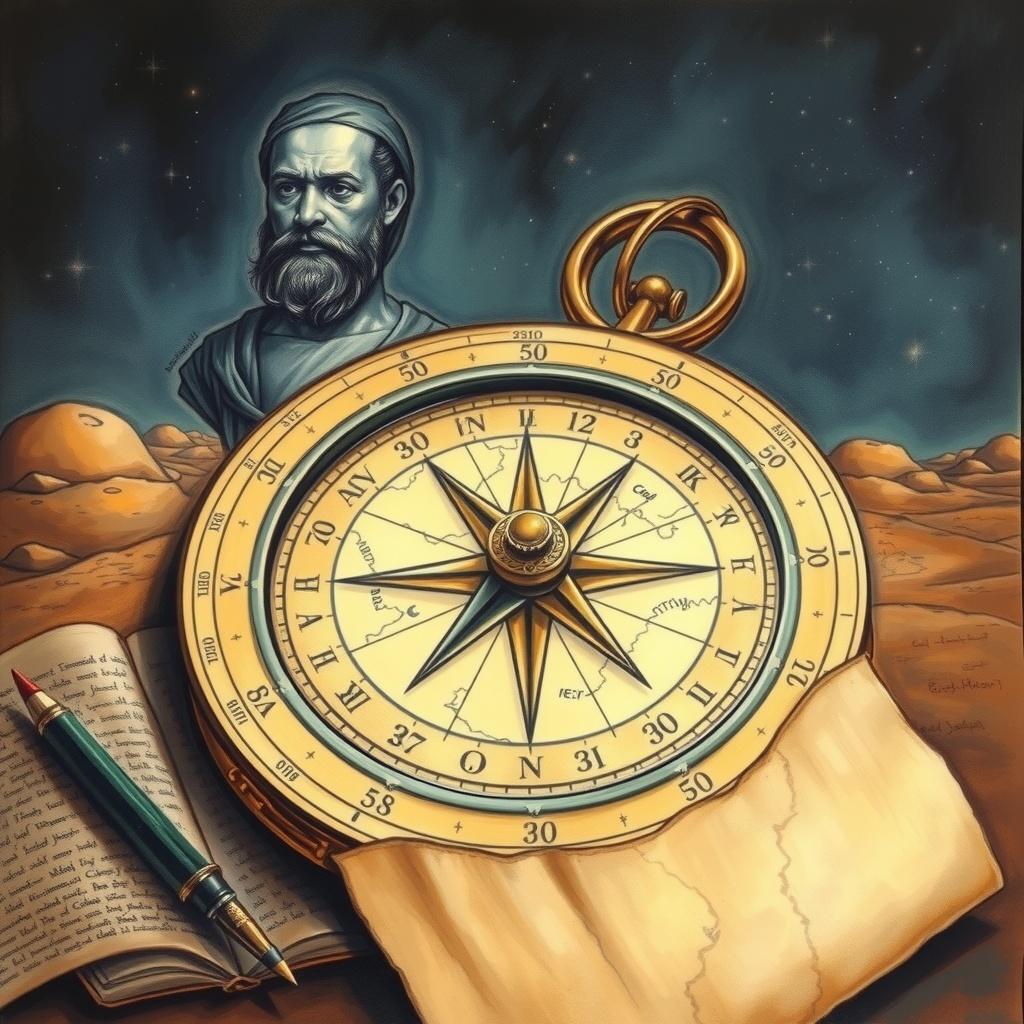
In the heart of Baghdad, a young scholar named Ali ibn al-Mansur wandered through the lively bazaar. His mind was a whirl of thoughts as he contemplated the mysteries of navigation and the stars. "There must be a way to guide travelers across the seas without relying solely on the sun and stars," he murmured to himself.
Ali sat hunched over a collection of ancient texts, his eyes scanning for any hint of knowledge that could assist him. As he turned the pages, he stumbled upon a reference to a mysterious lodestone, a rock with magnetic properties. "Could this be the key?" he wondered aloud, his excitement growing.
With determination, Ali began experimenting. He carefully suspended a small, needle-shaped piece of iron above a bowl of water, aligning it with the lodestone. As he watched, the iron needle pivoted to point north. "Eureka! This is it!" he exclaimed, his heart racing with triumph.
Ali stood before an audience of esteemed scholars and merchants, his compass proudly displayed on the table. He demonstrated its ability to consistently point north, regardless of the time of day or weather conditions. The crowd murmured in awe, realizing the potential of this invention. "With this compass, we can navigate the seas with certainty," he declared confidently.
As word of his invention spread, Ali ibn al-Mansur was celebrated across the Islamic world and beyond. His compass became an indispensable tool for explorers, revolutionizing navigation for centuries to come. Reflecting on his journey, Ali felt a deep sense of fulfillment. "The stars guided me, and now my compass will guide others," he thought with a smile.