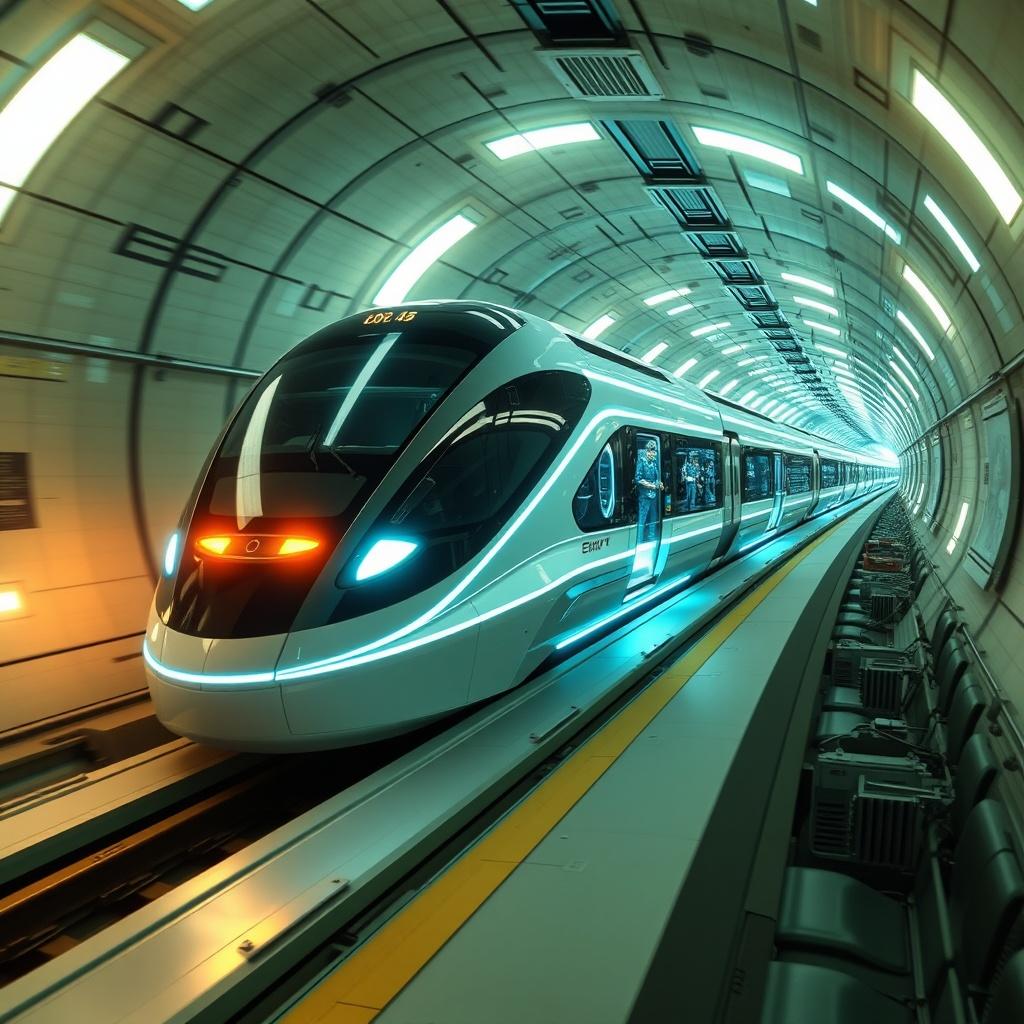
The atmosphere crackled with the promise of history in the making. Reporters hustled for the best shots, their flashes dancing along the train’s sleek interior. Engineers in crisp uniforms escorted VIPs, while the staff moved with practiced grace, ensuring every detail was perfect. The hum of the magnetic field drive was a comforting whisper, barely perceptible over the passengers’ chatter.
Maya Lin, a renowned technology journalist, pressed her palm to the window, wide-eyed. "It’s like flying without leaving the ground. How is it so silent at this speed?" The train’s AI chimed in, its voice mellifluous and reassuring. Passengers reclined in their adaptive seats, nano-cloth armbands syncing with the train’s systems to customize lighting and climate. The world outside blurred as the HTR reached hypersonic velocity, the tunnel’s energy harnessed to power every luxury within.
The AI’s voice cut through the tension: "An emergency stop has been performed due to detection of a biological object ahead. Please remain calm." Dr. Henrik Jansen, a systems engineer, conferred with the staff, his brow furrowed. "We’ve lost signal from one of the train’s rear modules—this is unprecedented," he whispered, eyes darting over diagnostics. Passengers strained to see through the reinforced windows, but all that greeted them was the endless tunnel, dim and foreboding.
Rumors ripple through the cabins—some speak of sabotage, others of tunnel creatures. Elena Popov, a calm-headed crew leader, moved through the aisles, offering reassurances. "We’re in constant contact with the rescue teams. Please trust the process," she urged, even as worry flickered in her eyes. The AI monitored vital signs and mood levels, its soothing updates becoming the sole anchor for hope.
Liam Rees, the chief rescue coordinator, addressed the passengers via intercom. "For your safety, evacuation will proceed in stages—please follow staff instructions closely. The tunnel is secure, but time is of the essence," he announced. Hundreds of passengers, armbands pulsing softly, filed into the tunnel, their voices echoing as they shuffled past the gleaming hulk of the stranded train. The sight of the water creeping closer spurred them onward, hope mingling with fear.
Maya Lin stood at the new terminal, notebook in hand, as officials announced the rebuilding of the HTR Norwich-Amsterdam line. "What matters most is that we learned. The next generation will be safer, stronger—ready to connect the world," she reported, her voice resolute. Twenty-four years later, the gleaming new tunnel welcomed a new generation of trains, a testament to human resilience and the enduring dream of seamless continental travel.